Strategies for thought leadership, publishing, and turning expertise into authority.
Featured
Ghostwriting · 8 min read
How Much Does a Ghostwriter Cost? 2026 Price Guide
Ghostwriter costs range from $2,000 to $250,000+ depending on the approach. This complete 2026 pricing guide breaks down traditional, hybrid, and AI-powered ghostwriting costs so you can find the right option for your budget.
Ghostwriter costs range from $2,000 to $250,000+ depending on the approach. This complete 2026 pricing guide breaks down traditional, hybrid, and AI-powered ghostwriting costs so you can find the right option for your budget.
Thinking about hiring a ghostwriter for your nonfiction book? From manuscript ownership to pricing structures, here are five things every expert author needs to know before signing anything.
Considering hiring a ghostwriter? Compare AI-powered ghostwriting with traditional ghostwriters across cost, timeline, voice accuracy, and copyright ownership to find the best fit for your book.
From first interview to finished manuscript — how long does ghostwriting actually take? Compare realistic timelines across traditional, hybrid, and AI-powered approaches with a month-by-month breakdown.
Should you hire a freelancer through Reedsy or use a full-service ghostwriting provider? Compare the marketplace model vs. managed services across cost, quality, voice consistency, and project management.
Looking for Scribe Media alternatives? Compare top book writing services across price, timeline, voice quality, and copyright ownership to find the best fit for your nonfiction book.
You don't need to be a writer to publish a great book. Explore five methods for creating a book without writing — from traditional ghostwriters to AI-powered services that turn your voice into a manuscript.
Is Dictate a real business? Are there independent reviews? How much does it charge, and who owns the book? The founder answers plainly, in his own Voice DNA.
A book ghostwriter writes your manuscript so you can publish it under your own name — legally and ethically. Learn how the process works from first call to finished draft, what it typically costs, and how AI-assisted ghostwriting changes the equation.
Knowing how to write a nonfiction book is only half the battle — structuring your expertise so readers act on it is the other half. This guide walks through every phase, from core idea to finished manuscript, including a faster path for busy professionals.
A memoir ghostwriter turns your lived experiences into a publishable book — but costs, quality, and process vary widely. This guide breaks down real price tiers, what the collaboration looks like, and how to choose a ghostwriter who delivers a manuscript worth reading.
Mike Giannulis··11 min read
Writing an Authority Book
How experts plan, outline, structure and write a nonfiction book, including writing it from interviews.
For consultants, coaches, and advisors, an authority book is a credentialing device — not a product. Here’s what it does for your business, why the traditional paths fail, and how to write one by talking instead of typing.
Discover how to create compelling authority book outlines that position you as a thought leader in your industry. Learn proven frameworks and avoid common mistakes.
Writing a book from interviews is one of the fastest ways professionals build thought leadership without staring at a blank page for months. Here's exactly what the process looks like in 2026—and what to watch out for.
A strong memoir structure template is the difference between a manuscript that resonates and one that gets abandoned halfway through. This guide breaks down five essential things every memoir writer needs to know about structure, from autobiography frameworks to real-world examples.
How much do you have to talk before there is a book? We pulled our own production numbers: hours of conversation per chapter and per manuscript, words of draft per hour, and what the same hours build for your voice after the book.
Mike Giannulis··8 min read
Publishing, Launch & Book Marketing
Self-publishing, traditional and hybrid publishing, launch plans and Amazon marketing for nonfiction authors.
Choosing between self-publishing and traditional publishing in 2026 means weighing royalty rates as low as 8% against timelines as short as 90 days. This data-driven comparison covers five major publishing paths — including hybrid and AI-assisted models — so you can match your goals to the right route.
Hybrid publishing sits between traditional and self-publishing — but the cost, quality, and control vary dramatically. Here are five things every expert author must know before signing a contract in 2026.
A strong book launch strategy separates authors who sell hundreds of copies from those who sell thousands. This guide covers the five things every author must know in 2026 — from building a pre-launch audience to structuring a book funnel that converts readers into clients or speaking opportunities.
Amazon book marketing is more competitive than ever in 2026, but most authors are spending money in the wrong places. This guide breaks down services, consultant costs, and proven strategies so you can make informed decisions before you invest a dollar.
Barnes & Noble Press lets authors publish eBooks and print books at no upfront platform cost — but the real expenses lie in editing, cover design, and production. This breakdown covers every fee you'll encounter, from ISBN procurement to print-on-demand margins, so you can budget accurately before you launch.
Traditional publishing offers prestige, distribution, and no upfront cost—but the path is longer and more competitive than most writers expect. This guide walks through every step, from manuscript to bookstore shelf, with honest benchmarks on timelines, advances, and what it takes to get a "yes."
What will it actually cost to publish your book on Amazon? This guide works like an Amazon self-publishing cost calculator — breaking down every KDP fee, royalty tier, and optional service from a $0 DIY budget to a $250K premium launch.
Understanding the steps on how to publish a book means choosing your path first—traditional, self-publishing, or hybrid—then executing each stage in the right order. This guide breaks down every phase, compares your options with real data, and helps you decide which route fits your goals.
Publishing a book on your own is more accessible than ever, but the path from manuscript to shelf involves more decisions than most first-time authors expect. This guide walks you through every stage — writing, editing, formatting, distribution, and marketing — with real numbers and no fluff.
Self publishing costs vary widely — from a few hundred dollars to several thousand, depending on how much professional help you hire. This breakdown covers every line item, from editing and cover design to ISBNs and distribution, so you can budget with confidence.
Publishing a book independently is more accessible than ever, but the path from finished manuscript to bookstore shelf involves more decisions than most first-time authors expect. This guide walks you through every major milestone — from ISBN registration to launch-day marketing — with concrete benchmarks and no fluff.
How hard is it to publish a book? The answer depends almost entirely on which publishing path you choose. This breakdown covers traditional publishing acceptance rates, self-publishing realities, timelines, and what it actually takes to get your book into readers' hands.
From first draft to finished book, publishing timelines vary wildly depending on the path you choose. Traditional publishing can stretch 2–5 years; self-publishing can be done in under six months. Here's every stage explained, with realistic time estimates for each route.
Getting a publishing company to publish your book is a defined process — not a lottery. This guide walks through every stage, from finishing your manuscript to negotiating a deal, so you can pursue the right path with realistic expectations.
Getting a publisher to publish your book requires understanding which publishing path fits your goals, then executing that path correctly. This guide breaks down traditional, hybrid, and self-publishing routes with real process steps, costs, and what each path actually demands.
Publishing on Amazon through Kindle Direct Publishing is free to set up, but the details—ISBNs, BISAC codes, royalty tiers, and print-on-demand logistics—trip up most first-time authors. This guide walks through every step with real numbers, from account creation to what authors actually earn per sale.
Publishing a book involves far more than finishing a manuscript — you'll choose between traditional and self-publishing, navigate editing, ISBN registration, distribution channels like Ingram and KDP, and launch strategy. This guide walks through every stage so you know exactly what to expect before you start.
Self-publishing puts you in full control of your book — but the path from manuscript to market has more steps than most first-timers expect. This guide breaks down the exact process, the real costs, and where professional help pays off.
Wondering how much it will cost to publish a book? The answer depends heavily on which publishing path you choose and how much professional support you need. This breakdown covers every cost category — editing, design, formatting, distribution, and marketing — with real price ranges so you can budget with confidence.
Mike Giannulis··9 min read
AI-Assisted Writing, Voice & Copyright
What AI can and cannot do for a book, how Voice DNA keeps it in your voice, and who owns the copyright.
Discover what AI can and cannot do when it comes to book writing. Learn the capabilities, limitations, and practical applications of AI in modern publishing.
Thinking about using an AI book writing service in 2026? Here are five things every author, entrepreneur, and consultant needs to know before committing — including real cost benchmarks and what AI can (and can't) do on its own.
Can ChatGPT write your book? Technically yes. Should it? No — and here is why. Compare generic AI prompting with purpose-built ghostwriting systems across voice, quality, consistency, and copyright.
Voice DNA is the proprietary technology that makes AI-written books sound like the author, not a robot. Learn how 6 voice components are analyzed across interviews to achieve 95%+ voice accuracy.
The copyright question is the #1 concern for authors considering AI writing tools. Here is the definitive 2026 legal analysis: what is copyrightable, what is not, and why interview-based AI books clear every legal hurdle.
Dictate Team··12 min read
Why Write a Book: ROI, Leads & Speaking
The business case for a book: client acquisition, lead generation, speaking fees and positioning.
Publishing a book isn't just a creative pursuit—it's a strategic business decision that demands a structured case. Learn the five things every professional must know before committing to the process in 2026.
Learn how to transform your expertise into a powerful lead generation engine with book marketing. This comprehensive guide covers strategies, implementation steps, and proven tactics for using books to attract and convert prospects.
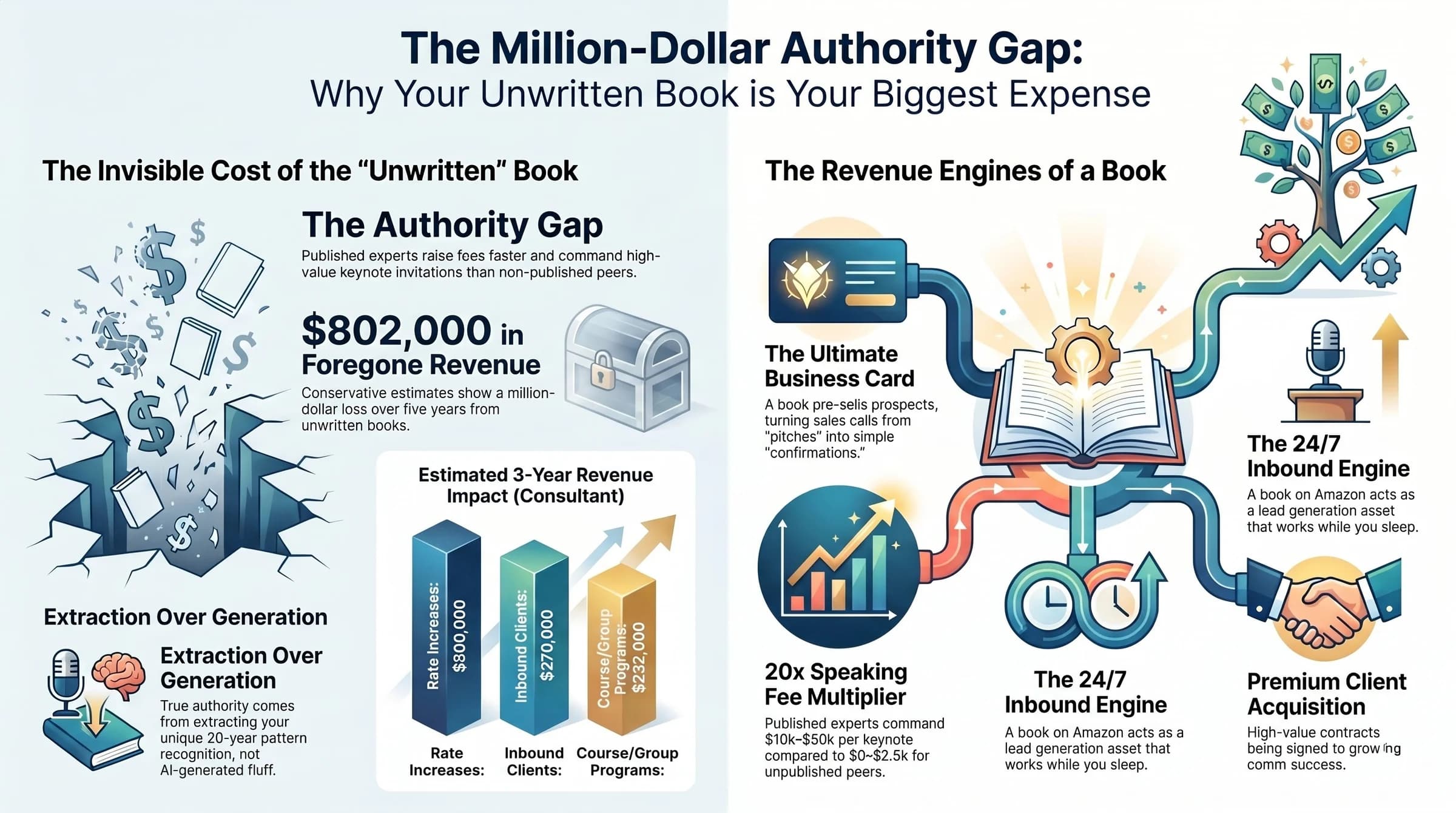
Speaking bureaus and conference organizers treat a published book as one of the strongest credibility signals they vet — and the data shows it can raise speaking fees by 50% to 200% or more. But the book alone isn't enough. Here's what the research actually says about the consultant-to-keynote transition.
Dictate Team··9 min read
Books for Consultants
How consultants turn a methodology into a book that wins clients, licenses workshops and outlives its creator.
A published book is the highest-leverage marketing asset a consultant can own. Learn how to turn your consulting methodology into a book that generates inbound leads and premium positioning.
The management consulting book landscape has never been richer — or more crowded. This breakdown cuts through the noise with curated recommendations for every experience level, from first-year analysts to principals building a thought leadership practice.
Your workshop IP is sitting in PowerPoint decks when it could be generating licensing revenue. Research shows 67% of L&D professionals say training positively impacts revenue — but only when that content is standardized, reusable, and packaged beyond the live room. Here's how corporate trainers are making that leap.
The methodology that took you 20 years to build lives in your head, your slide decks, and your instincts — nowhere a client or junior partner can follow without you in the room. Research shows that books driven by consulting frameworks generate a median $50,000 in downstream consulting revenue, yet most firms never formally document their approach at all. Here's why methodologies die, and what partners are doing about it.
Mike Giannulis··11 min read
Books for Coaches
How coaches turn their method into a book, raise their rates and build programs around it.
Publishing your coaching methodology doesn't mean sacrificing your authentic voice for academic jargon. Discover how successful coaches transform their frameworks into powerful business assets.
ICF-credentialed coaches earn a median $272/session versus $148 for non-credentialed coaches — an 84% premium. But credentials alone aren't the ceiling. The coaches charging $6,000–$25,000+ for a three-month engagement share one more differentiator: a published book that converts authority into pricing power.
Writing a book as a career coach can establish credibility, attract premium clients, and create a scalable asset from your coaching methodology. Here's exactly what to expect in 2026—from concept to published manuscript.
A published book isn't just a credibility signal — it's the curriculum backbone that lets coaches scale from one-on-one sessions to $30,000+ cohort programs. Real community data shows coaches structuring multi-session group programs around a single book's chapters, exercises, and frameworks. Here's exactly how the model works, what it pays, and how to build it.
Book coaching services help authors plan, write, and finish their books with structured guidance — but costs, formats, and outcomes vary widely. Here's how to evaluate your options and find the right fit.
Book writing coaching pairs you with an expert who structures your manuscript, holds you accountable, and closes the gap between "I have an idea" and a finished book. Here's how the process works, what coaches charge, and how to decide if you need one.
Book coaching pairs a writer with a trained guide who helps them finish a manuscript worth publishing—providing structure, craft feedback, and accountability throughout the process. This guide explains what book coaches do, what they charge, and how to evaluate whether you need one.
Mike Giannulis··10 min read
Books for Doctors & Health Practitioners
How physicians, surgeons, dentists and practitioners use a book to build reputation, educate patients and grow a practice.
Medical authorship has increased 46% in recent years, with specialist physicians discovering that publishing books dramatically accelerates their careers while solving the crisis of unreliable health information online.
Most surgeons rely on journal articles to build credibility — but peer-reviewed papers almost never generate a phone call from a national news producer. A growing body of evidence from publishing history and modern surgeon-memoir trends shows that a single consumer-facing book can do what 530 academic citations cannot: make a specialist's name recognizable outside the medical community.
Google reviews are no longer enough to differentiate a dental or specialist practice in a crowded market. A growing number of dentists, orthodontists, and cosmetic specialists are turning to books — not as vanity projects, but as high-trust lead magnets and premium positioning assets that attract patients who are actively seeking expertise, not bargain pricing.
When Clayton Christensen co-authored The Innovator's Prescription, he didn't just describe a new healthcare model — he normalized it for an entire industry. For today's healthcare executives, publishing a book remains the most powerful tool for turning a novel care model into a field-wide movement.
Research reveals that well-designed patient education materials can dramatically improve patient outcomes and practice efficiency. Learn how successful physicians are using targeted educational books to reduce repetitive consultations while enhancing patient care.
Leading functional medicine practitioners like Dr. Mark Hyman and Dr. Amy Myers have transformed their practices through strategic book publishing, positioning themselves as thought leaders while attracting thousands of aligned patients.
Whether you're a clinician building authority positioning or a practitioner deepening your knowledge, the right functional medicine book can define your professional trajectory. This guide breaks down formats, platforms, and use cases—including PDF resources, Amazon options, and titles built for nurse practitioners.
Dictate Team··11 min read
Books for Financial Advisors & CPAs
How advisors and accountants use a compliant book to win clients and grow assets under management.
One Milwaukee-based advisor built a targeted content engine and added 18 new clients and roughly $108,000 in new annual recurring revenue. A published book operates on the same logic—but with stronger trust signals, longer shelf life, and compliance obligations advisors can't afford to ignore.
Compliance revenue is commoditizing fast, and CPA firms that rely on it are losing ground to software and offshore providers. Research shows that the firms making the leap to advisory do three things simultaneously: free up capacity, package expertise, and publish thought leadership that earns trust before asking for a sale. A book is one of the highest-leverage tools in that third step.
Mike Giannulis··11 min read
Books for Real Estate Professionals
How agents, brokers and investors use a book to win listings, recruit agents and raise capital.
Discover proven strategies for real estate agents to write books that establish authority, generate quality leads, and differentiate their business in competitive markets.
Recruiting top real estate agents has never been more competitive — but the brokerages winning aren't just posting better job ads. They're building authority, codifying culture, and publishing content that makes agents seek them out. Here's what the research actually shows works.
Successful real estate syndicators like Joe Fairless have discovered that books serve as powerful credibility tools for attracting limited partners and private capital. The most successful investment books focus on practical strategies and proven systems.
Dictate Team··7 min read
Books for Lawyers
How attorneys use a client-education book to generate cases and referrals.
Business attorneys who publish a focused legal guide for entrepreneurs stop chasing emergency clients and start attracting them proactively. Research shows that books tied to a clear acquisition channel — SEO, LinkedIn, referral networks — are the ones most explicitly linked to measurable firm growth. This article breaks down exactly how to build that system.
Mike Giannulis··10 min read
Books for Founders & Tech Leaders
How founders, CTOs and executives use a book to raise, recruit, scale culture and document their methods.
Writing a book as a tech founder is one of the highest-leverage credibility moves you can make — but most founders underestimate what it actually takes. This guide breaks down the process, common pitfalls, and how to finish without derailing your company.
Competitors can clone your architecture, but they can't clone the documented methodology behind it. Research shows that the most influential CTOs use published books not just to learn IP strategy, but to stake a permanent, public claim on their technical thinking — before someone else does.
The most influential technology disruption books don't just describe market shifts — they create the vocabulary that investors, founders, and incumbents use to frame competition. For tech founders with a contrarian thesis, a published book isn't a vanity project: it's the strategic asset that earns media authority and reshapes how your market thinks. Here's the data behind why it works.
66% of candidates rate culture as the top factor in a career move—yet most scaling startups rely on internal wikis that capture the what but never the why. Here's how technology founders are using culture books to preserve founding principles as they grow from 50 to 500 employees, backed by community research and industry data.
Creative leaders are transforming their intuitive design processes into published methodologies that teams can learn and apply. From IDEO's toolkits to Stanford's reading list, discover the patterns that make design process books successful.
Dictate Team··10 min read
Books for Pastors & Ministry Leaders
How pastors turn sermons and teaching into books, devotionals and leadership resources.
Discover the complete roadmap to becoming a successful faith-based author. Learn proven strategies for writing, publishing, and building authority in Christian publishing.
Your congregation has been asking for years. Your sermons contain enough material for a dozen books. The real question isn't whether you have something worth publishing — it's knowing the proven workflow that turns pulpit messages into pages readers can hold. Here's what pastor-authors actually do, backed by community research and publishing industry insight.
Most published devotionals miss the mark for local congregations because they weren't written for your community, your sermon series, or your members' specific spiritual needs. Here's how ministry leaders are building devotional books that actually get read — and how a focused, Scripture-anchored structure makes all the difference.
Mike Giannulis··11 min read
Books for Educators & Academics
How professors, teachers and science communicators turn courses and research into books.
The digital education content market is exploding from $24.51 billion to $249.17 billion by 2034, yet most educators don't know how to transform their unique courses into lasting textbooks. Here's the research-backed roadmap to turn your scattered course materials into a published legacy.
Most researchers assume writing for a general audience means dumbing their work down — but the evidence says otherwise. The scientists who become successful public intellectuals don't simplify their research; they repackage it into audience-centered stories that preserve full accuracy. Here's what the science communication literature actually says about making that transition.
Mike Giannulis··10 min read
Dictate Affiliate Program
For partners who refer authors to Dictate: program details, platforms, and disclosure rules.
Dictate now runs a free affiliate program for creators whose audiences include coaches, consultants and other experts who want to write a book. Here's what you'd promote, how commissions work on JVZoo, ClickBank and Digistore24, the materials you get and the rules that keep recommendations honest.
The best affiliate programs for coaches and consultants protect the trust your audience already gives you. Here are five questions to ask before you promote any offer, the red flags to avoid, and a worked example using Dictate's program.
JVZoo, ClickBank and Digistore24 often carry the same digital products, but they differ in how you get approved, what your link looks like and where you read your results. Here's a neutral comparison from each network's own help pages, plus how to promote Dictate on each one.
Affiliate programs give podcast hosts a flexible alternative to traditional sponsorships, as long as the offers fit the show and the disclosures are said out loud. Here's how to choose offers, mention them on air, set up show notes and track each episode.
A good affiliate disclosure is short, plain and right next to the link. Here are ready-to-adapt examples for every channel, the placement rules that matter most, and how Dictate's affiliate program builds disclosure into its materials.
Mike Giannulis··7 min read
Ready to Write Yours by Talking?
Watch Mike's free training and see if Dictate is the right fit for your book.