The Business Case for Writing a Book: ROI and Clients
Mike Giannulis··10 min read
Most professionals who consider writing a book spend months agonizing over topic and title—and almost no time building a business case for publishing a book. That imbalance is precisely why so many books fail to generate a return in clients, fees, or opportunities. A book without a business rationale is a hobby. A book with one is an asset. In 2026, as the market for nonfiction and business titles continues to grow alongside AI-assisted writing tools, the professionals who treat book publishing as a strategic initiative—complete with a plan, a format, and a measurable goal—are the ones capturing the upside.
According to data analyzed by publishing strategist Jane Friedman, publishers increasingly rely on quantitative market signals to decide what to publish—and smart authors are doing the same before they write a single word. The question isn't whether you should write a book. The question is whether you can justify it on paper first.
This article breaks down five essential things every professional, entrepreneur, or subject-matter expert needs to understand about the business case for publishing a book—from how to structure a publishing business plan to what format your case document should take. Whether you're building a book funnel for your consulting practice or positioning yourself for the speaking circuit, the framework below will help you make the decision with clarity.
What a Business Case for Publishing a Book Covers
A business case for publishing a book is a structured argument—usually a written document—that demonstrates why investing time, money, and reputation into authorship makes strategic sense. It answers three core questions: What is the goal? What will it cost? And what will it return?
This is not the same as a book proposal (which is written for publishers) or a marketing plan (which comes after the book exists). The business case comes first. It is the internal or client-facing document that says: here is why writing this book is the right move for this business, at this time, for this audience.
Why the Business Case Matters More Than the Book Idea
A compelling book idea is table stakes. What separates professional authors from frustrated ones is a clear understanding of what the book is supposed to do. Is it a thought leadership tool designed to open doors with enterprise clients? Is it a back-of-room sales product for live events? Is it an anchor for a course or coaching program? Each of these use cases implies a different strategy, a different format, and a different definition of success. If you're still deciding whether a book is the right vehicle, the section below on how a book grows your business can help clarify the decision.
A business case forces you to define success before you begin—which is the single most effective way to build a book that actually achieves it. Services like Dictate are built around this principle: the strategy comes before the writing.
What You'll Learn in This Article
Where a book's return actually comes from: credibility and revenue
How to write a business plan specifically for publishing
What business case writing actually involves
How long your case document needs to be
Which format and structure to use
Best practices to avoid the most common mistakes
How a Book Grows Your Business: Credibility and Revenue
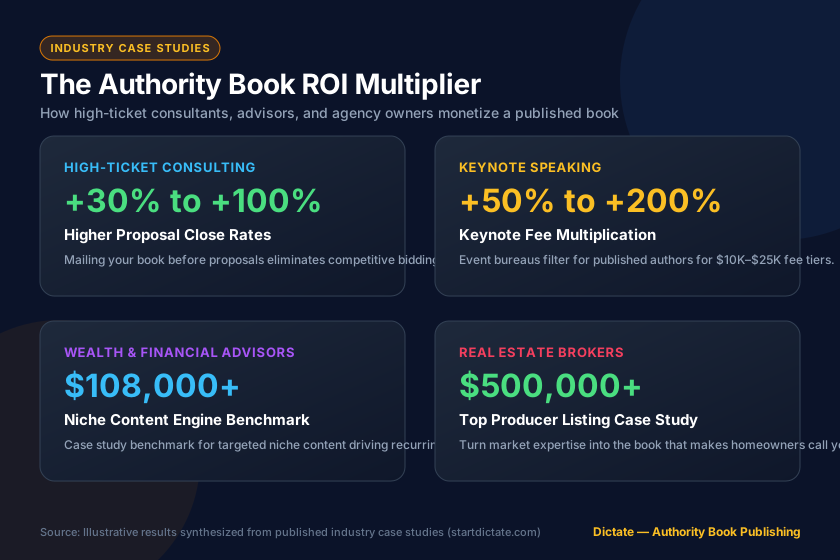
The return side of any business case rests on two things a book does that most marketing cannot. It raises your credibility, and it opens revenue streams that have little to do with copies sold.
The Credibility Multiplier
A published book amplifies every other part of your business presence. Prospects equate authorship with deep knowledge and proven experience, so speaking invitations, consulting rates, and sales conversations all start from a stronger position. The mechanism is social proof: a finished, structured body of work is evidence that a blog feed or a slide deck cannot provide.
This is also where a book parts ways with content marketing. A blog post shows that you can write. A book shows that you can think, organize, and sustain an argument at length, and buyers treat those as different achievements. Articles, podcasts, and social posts are useful, but they are cheap to produce and just as cheap to dismiss. A book takes real time and intellectual investment, and that cost is exactly what makes it a credible signal.
Revenue Streams Beyond Royalties
Royalties are usually the smallest line in an author's return. The larger returns tend to come from:
Consulting and coaching engagements at higher rates
Speaking engagements and workshop facilitation
Online courses and digital products built on the book's framework
Licensing and partnership opportunities
Media appearances and invitations to industry panels
Each stream reinforces the others. A keynote fills a workshop, the workshop produces consulting clients, and those engagements supply the case studies for your next edition. Speaking is often the fastest of these to move, and there is a full breakdown of how a book raises speaking fees if that is your main goal.
Market Positioning and Shorter Sales Cycles
In a crowded market, a book puts you in a different category in the prospect's mind. Competitors may offer similar services, but you are the one who wrote the book on the problem. Because prospects can read your thinking before the first call, much of the trust-building happens before any sales conversation, which tends to shorten sales cycles and raise win rates. Professional-services firms feel this most; attorneys, for example, use a client-education book to win cases before the crisis hits.
Share or Embed this chartFree with attribution
Click box to copy embed code to clipboard (or press Ctrl/Cmd+C).
How to Build a Business Plan for Publishing a Book
A business plan for publishing a book is different from a general publishing plan. It's not a production schedule or a marketing calendar—it's a strategic document that situates the book within your broader business goals and lays out a realistic path to ROI.
Step-by-Step: Building Your Publishing Business Plan
Define the strategic goal. Are you seeking speaking engagements, attracting consulting clients, building credibility in a new market, or generating passive income? Each goal shapes every subsequent decision.
Identify your target reader precisely. Not "entrepreneurs" but "early-stage SaaS founders navigating their first hire." Specificity is the difference between a book that resonates and one that sits unsold.
Estimate total investment. Include ghostwriting or dictation services, editing, design, ISBN and distribution costs, and launch marketing. According to the Independent Book Publishers Association, a professionally produced nonfiction book typically costs between $5,000 and $20,000 from manuscript to market.
Project revenue and non-monetary ROI. Book royalties rarely justify the investment alone. The real return is in what the book enables: authority positioning, inbound leads, back-of-room sales, media coverage, and speaking fees.
Set a timeline. Realistic nonfiction timelines run 6–18 months from concept to published. AI-assisted dictation workflows, like those offered through Dictate's process, can compress this significantly.
Common Challenges
The most frequent mistake professionals make is underestimating the non-writing costs—editing, design, and distribution—while overestimating book sales revenue. A business plan that treats the book as a lead-generation tool rather than a profit center sets more realistic expectations and tends to produce better strategic outcomes. For the mechanics of that approach, see how to turn your book into a source of qualified leads.
Business Case Writing, Explained
Business case writing is the discipline of constructing a logical, evidence-based argument for a proposed initiative. In corporate contexts, it's used to justify capital expenditures, new product launches, or organizational changes. When applied to publishing, it follows the same logic: you're asking stakeholders—whether that's a business partner, a publisher, an investor, or yourself—to approve an allocation of resources.
The Core Components of a Business Case Document
Executive summary: A one-page overview of the proposal and its projected outcomes
Problem or opportunity statement: Why does this book need to exist? What gap does it fill?
Options analysis: What alternatives exist (e.g., a blog series, a course, a podcast)? Why is a book the right vehicle?
Cost-benefit analysis: Projected investment vs. projected return, both financial and strategic
Risk assessment: What could go wrong, and how will you mitigate it?
Recommendation and next steps: A clear call to action with owners and timelines
Real-World Application
Consider a financial advisor who wants to write a book on retirement planning for women over 50. The business case would demonstrate that this audience is underserved in the current publishing market, that the advisor's firm serves 400+ clients in this demographic, that the book would anchor a book funnel directing readers toward a free consultation, and that a conservative estimate of 10 new clients per year at an average AUM would generate six figures in new revenue annually. That's a business case—not a book idea.
Common Challenges in Business Case Writing
Writers often conflate passion with strategy. A topic you care deeply about is not, by itself, a business case. The discipline of business case writing forces you to separate enthusiasm from evidence—and that rigor is what makes the resulting book more purposeful and more profitable.
How Many Pages Should a Business Case Be?
One of the most practical questions professionals ask when building a business case for publishing a book is simply: how long should this document be? The answer depends on the audience and the stakes involved.
General Page-Count Guidelines
Audience / Context
Recommended Length
Key Focus
Personal decision-making (solo author)
2–5 pages
Goal clarity, cost estimate, ROI projection
Business partner or co-author buy-in
5–10 pages
Options analysis, shared ROI, roles and responsibilities
The page count of your business case should be proportional to the stakes. A solo practitioner deciding whether to invest $8,000 in a dictated manuscript doesn't need a 20-page document. A corporation launching a thought leadership book series to support a $2M sales initiative absolutely does. Match depth to decision complexity.
What the Research Suggests
According to the Project Management Institute's research on business case development, the most effective business cases are concise, structured, and jargon-free—regardless of length. A bloated 30-page document with weak data is less persuasive than a focused 8-page case with tight financials and a clear recommendation.
Why Business Case Format Examples Matter
Format is not cosmetic. The structure of your business case format determines whether your argument is readable, persuasive, and actionable. Professionals who skip format considerations often produce documents that are technically complete but strategically ineffective—because the decision-maker can't find the key information quickly.
Standard Business Case Format for Publishing
Title Page: Book working title, author name, date, version number
Executive Summary (1 page max): The "so what"—projected outcome and recommended action
Strategic Context: How the book fits within the author's or organization's broader goals
Implementation Plan: Key milestones, owners, and deadlines
Appendices: Competitive title analysis, sample chapter, author bio
Format Examples by Use Case
The Thought Leadership Book: This format emphasizes authority positioning and audience trust. The market opportunity section focuses on credibility gaps in the industry. The ROI section quantifies speaking fees, media placements, and inbound consulting leads rather than book sales. For help structuring this type of book, see our guide to writing an authority book that wins clients.
The Book Funnel Anchor: This format is built around conversion. The investment section includes funnel infrastructure costs (landing pages, email sequences, ads). The ROI section models cost-per-lead and lifetime customer value.
The Corporate Thought Leadership Series: This format looks most like a traditional corporate business case, with departmental budget alignment, brand consistency guidelines, and multi-book projections. The executive summary is written for a C-suite reader who will spend fewer than three minutes on the document before deciding.
Common Format Mistakes
Burying the executive summary, using dense narrative where bullet points would serve better, and omitting a risk section (which signals naivety) are the three most common format errors. A well-formatted case signals professional seriousness—and that signal matters as much as the content itself.
Best Practices for Building a Business Case for Publishing a Book
Having a framework is one thing. Executing it effectively is another. Here are the practices that consistently separate strong publishing business cases from weak ones.
Tip 1: Anchor Every Claim in Data
Publishers use market data to validate acquisition decisions, as Jane Friedman documents extensively in her analysis of how publishers use data to inform what they publish. You should do the same. Use tools like Publisher Rocket, NPD BookScan, or Amazon category research to validate that your target audience is actively buying books on your topic. Gut instinct is not a data point.
Tip 2: Model the Full Book Ecosystem, Not Just Sales
A book that sells 2,000 copies at $18 generates $36,000 in gross revenue—rarely enough to justify the investment on its own. But a book that generates 200 qualified leads, closes 10 consulting clients, anchors a speaking circuit presence, and drives back-of-room sales at three events per year can easily generate $300,000 or more in annual revenue. Model the ecosystem, not just the royalty check. The strongest cases plan for this full-funnel return from the start.
Tip 3: Define Success Metrics Before You Start
Before you write a word of your manuscript, define what success looks like at 6, 12, and 24 months post-publication. Metrics might include: number of speaking invitations received, number of inbound client inquiries attributed to the book, Amazon category ranking, media mentions, or email list growth. Without predefined metrics, you cannot evaluate whether the investment paid off—and you cannot improve your strategy for the next book.
Common Mistakes to Avoid
Treating the book as a vanity project with a business case slapped on top. The case should drive the book's content and format—not rationalize a decision already made.
Underestimating production costs. A professionally edited and designed book is not a $500 project. Budget realistically, or the business case will be built on false premises.
Ignoring the author platform requirement. The business case for a book is significantly stronger when the author has an existing audience. If you don't, your case needs to include a platform-building phase.
Skipping the competitive analysis. If three books published in the last 18 months already cover your exact topic for your exact audience, that's a risk your case must address—not ignore.
If you're ready to move from business case to manuscript, you don't have to face the blank page alone. Experts who want the book without the writing can hire a ghostwriting team that works from their interviews. You can also review our FAQ page for answers to common questions about timeline, process, and pricing.
Frequently Asked Questions
What is a business case for publishing a book?
It's a structured document that justifies the investment in authorship by outlining strategic goals, projected costs, and expected returns—both financial and reputational. It answers why this book, for this audience, at this time, makes strategic sense.
How is a publishing business plan different from a business case?
A business case answers whether to proceed. A business plan answers how to proceed. The case comes first—it's the go/no-go document. The plan is the operational roadmap that follows a positive decision.
How many pages should a business case for a book be?
For most individual authors and small business owners, 2–10 pages is sufficient. Corporate or organizational publishing initiatives may require 10–25 pages. The key principle is proportionality: match the depth of the document to the complexity and scale of the decision.
What should a business case format for a book include?
At minimum: an executive summary, a strategic context section, a market opportunity analysis, an itemized investment estimate, a return on investment projection, a risk assessment, and a clear implementation plan with milestones.
Can a book really generate ROI beyond royalties?
Yes—and for most professional authors, the non-royalty return is the primary ROI driver. Speaking engagements, consulting leads, course sales, back-of-room sales, and media credibility regularly generate multiples of what royalty income alone would produce. A well-structured business case models all of these revenue streams.
Start Building Your Publishing Business Case Today
The professionals who write books that matter—books that build careers, close clients, and establish lasting authority positioning—don't start with a blank page. They start with a plan. They build a business case. They know their audience, their market, their investment, and their definition of success before they dictate the first sentence.
Dictate was built for exactly this kind of intentional authorship. Founded by Mike Giannulis, whose own book Talk Your Book Into Existence came directly from a structured, strategic approach to publishing, Dictate helps professionals move from business case to finished manuscript with clarity and efficiency. Learn more about our approach, review our pricing options, or take the next step now.
How long does it take to see business results from a published book?
Most professionals see the first effects, such as speaking invitations and inbound inquiries, within a few months of publication. The larger gains build over the following year as the book circulates, gets referenced in sales conversations, and compounds your authority.
Do I need to sell thousands of copies for a book to pay off?
No. For most professional authors the return comes from authority positioning and lead generation, not copy sales. A book that reaches a few hundred of the right readers can generate more business than a bestseller written for a general audience.
A published book is the highest-leverage marketing asset a consultant can own. Learn how to turn your consulting methodology into a book that generates inbound leads and premium positioning.
Publishing your coaching methodology doesn't mean sacrificing your authentic voice for academic jargon. Discover how successful coaches transform their frameworks into powerful business assets.
Choosing between self-publishing and traditional publishing in 2026 means weighing royalty rates as low as 8% against timelines as short as 90 days. This data-driven comparison covers five major publishing paths — including hybrid and AI-assisted models — so you can match your goals to the right route.
Dictate Team··11 min read
Ready to Turn Your Expertise Into a Book?
Start with a free discovery call. No commitment, no pressure — just a conversation about your book.