Can You Copyright an AI-Written Book in 2026? (Yes, If…)
Dictate Team··12 min read
If you are considering using AI to help write your book, copyright is probably your biggest concern. Will you actually own your book? Can you register it? Will a publisher accept it? Could someone copy it without consequence? These questions are especially relevant for professionals exploring AI ghostwriting as a more affordable alternative to traditional ghostwriters.
These are legitimate questions. The legal landscape around AI and copyright has evolved rapidly, and there is both good news and nuance. This analysis covers every major ruling and guidance through 2026 — and ends with a practical checklist you can use before you publish or register.
One-sentence answer for busy authors: You can generally claim copyright only for the parts that reflect your original expression — the stories, examples, frameworks, edits, and selection/arrangement you actually contributed. AI can be a writing instrument; it does not make unreviewed, machine-invented prose fully yours just because you approved the file. If the model invents the expressive content from a thin prompt, those passages are typically not protectable.
The “Yes, If…” Checklist (When AI Books Are Copyrightable)
Condition
Pass if…
Fail if…
Human creative content
Stories, opinions, frameworks, and examples come from you (e.g. interviews)
You only typed a short prompt and published the raw output
Creative control
You decide structure, thesis, what stays/goes, and final wording approval
You never review drafts or cannot explain why the book says what it says
Selection & arrangement
Chapter order, emphasis, and narrative choices are yours
The system auto-generates a book you treat as disposable text
Documentation
You keep interviews, outlines, comments, and revision history
You have no record of human contribution if challenged
Honest registration
You disclose AI tools and describe your authorship role accurately
You claim pure human drafting when the work was machine-generated
Share or Embed this decision treeFree with attribution
Click box to copy embed code to clipboard (or press Ctrl/Cmd+C).
The Core Legal Principle
Copyright law in the United States protects works of authorship created by humans. The key question with AI is not "Was AI involved?" but rather "Did a human provide sufficient creative expression?"
This distinction makes all the difference.
Key Legal Precedents
Thaler v. Perlmutter (2023)
Stephen Thaler attempted to register a copyright for artwork created entirely by his AI system DABUS, listing the AI as the author. The U.S. District Court for the District of Columbia ruled that copyright requires human authorship — AI cannot be listed as an author, and works created entirely by AI without human creative input are not copyrightable.
Key takeaway: Works with zero human creative involvement cannot be copyrighted. This ruling does NOT say that works created with AI assistance are uncopyrightable.
Zarya of the Dawn (2023)
Kris Kashtanova registered copyright for a comic book called "Zarya of the Dawn," which used AI-generated images (Midjourney) with human-authored text and arrangement. The Copyright Office ruled:
The text (human-written) was copyrightable
The selection and arrangement of text and images was copyrightable
The individual AI-generated images were NOT copyrightable because the author could not predict or control the specific output
Key takeaway: When humans make creative decisions about selection, arrangement, and direction — even when AI tools are involved — those creative contributions are protectable.
US Copyright Office Guidance (2023–2026)
The Copyright Office has repeatedly confirmed the same core rules as AI tools proliferated:
Works must be created by a human to be copyrightable
Using AI as a tool (like using Photoshop or a word processor) does not disqualify a work from copyright protection
The key factor is whether the human exercised "creative control" over the expressive elements
Registration applications should disclose AI involvement and describe the human authorship contribution
Applicants who over-claim pure human authorship for machine-generated text risk invalid registrations and credibility damage
Through 2026, the practical industry read is stable: human-directed, AI-assisted books are protectable; autonomous AI authorship is not. Courts and the Office care about who originated the expression — not whether a model helped type it.
How This Applies to AI-Written Books
The legal framework creates a clear spectrum:
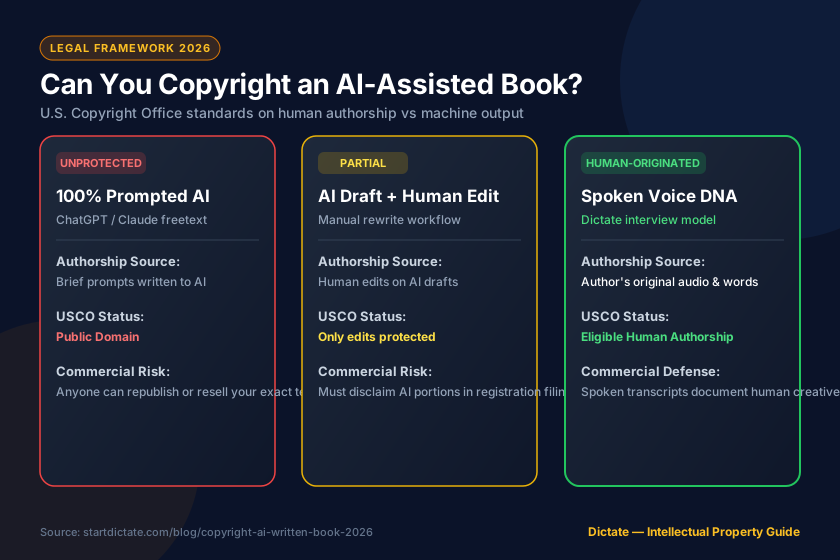
NOT Copyrightable: Pure AI Generation
If you type "Write me a book about leadership" into ChatGPT and publish the output, that work has minimal copyright protection. You provided a prompt; the AI provided the creative expression. You cannot meaningfully claim authorship of the prose, structure, or content.
Copyrightable: AI-Assisted Human Authorship
If you provide the content, creative direction, and approval — and AI serves as a writing tool — the work is copyrightable. The human is the author; the AI is the instrument.
Why Interview-Based AI Books Are Fully Copyrightable
Interview-based AI book writing (like Dictate's process) satisfies every requirement for copyright protection:
1. Human-Originated Content
Every story, framework, insight, opinion, and example in the book comes from the human author through interviews. The AI does not invent content — it captures and structures what the human provides. This is functionally identical to dictating to a human transcriptionist or ghostwriter. Keeping the book in your own words, not just your ideas, also depends on capturing your writing voice.
2. Human Creative Control
The author reviews every chapter, provides feedback, requests revisions, and approves the final manuscript. The human makes all creative decisions about what stays, what changes, and what the book ultimately says.
3. Human Selection and Arrangement
The book's thesis, structure, chapter organization, and thematic emphasis are all driven by the human author's expertise and preferences. The AI assists with execution, not creative direction.
4. Tool Use, Not AI Authorship
The AI functions as a sophisticated writing tool — similar to how a word processor, grammar checker, or voice-to-text software functions. The human is the author; the technology is the medium.
The Ghostwriter Analogy
Here is the most clarifying comparison: traditional ghostwriting has always been legally copyrightable by the credited author, even though another person (the ghostwriter) did the actual writing. Why? Because the credited author provided the content, creative direction, and approval.
AI-assisted writing follows the exact same legal logic. The medium changed (AI instead of a human ghostwriter), but the authorship framework is identical. For a detailed look at how AI and traditional ghostwriting actually compare, the distinctions are worth understanding — but from a copyright standpoint, the legal standing is the same.
Element
Traditional Ghostwriter
AI Ghostwriting (Dictate)
Content source
Author interviews
Author interviews
Creative direction
Author decides
Author decides
Writing execution
Human ghostwriter
AI system
Review & approval
Author reviews drafts
Author reviews drafts
Copyright owner
Author (by contract)
Author (by design)
Copyrightable?
Yes
Yes
Copyright Registration: Best Practices
When registering your AI-assisted book with the US Copyright Office:
List yourself as the author — You are the author. The AI is a tool.
Disclose AI involvement — Note that AI writing tools were used in the creation process.
Describe your contribution — "Author provided all content through recorded interviews, directed the book structure, reviewed all chapters, and approved the final manuscript."
Keep documentation — Retain interview recordings, revision history, and feedback records as evidence of your creative involvement.
What About Publishers?
Major publishers increasingly accept AI-assisted manuscripts, but policies vary. Most require disclosure of AI involvement. The industry consensus as of 2026 is that AI-assisted (human-directed) manuscripts are acceptable; purely AI-generated manuscripts are not.
For self-publishing (Amazon KDP, IngramSpark), there are no restrictions on AI-assisted works as long as you accurately represent authorship. Amazon's 2023 policy update requires disclosure of AI-generated content but does not prohibit it.
Protecting Your Book
Once your AI-assisted book is published and registered:
Copyright protection applies normally — Others cannot reproduce, distribute, or create derivative works without your permission
DMCA takedown rights apply — You can enforce against unauthorized copies online
Licensing and subsidiary rights are yours — Foreign translation, audiobook, film/TV adaptation rights are all yours to negotiate
For Dictate clients specifically: you own 100% of the copyright, pay zero royalties, and retain all subsidiary rights. This is non-negotiable and contractual.
Common Failure Modes (What Breaks Copyright Claims)
Prompt-only books: One paragraph of instructions, 50,000 words of unreviewed model output.
No revision trail: You cannot show how human judgment shaped the manuscript.
Misrepresentation on registration: Claiming purely human drafting when tools produced the prose.
Ambiguous service contracts: A vendor retains rights or is vague about assignment — fix this before interviews start.
Mixing public-domain / scraped material: Even human-directed books can create infringement risk if sources are not original to you.
If you are comparing production models for an authority book, copyright clarity should sit next to price and timeline — see Scribe alternatives and Reedsy vs full-service.
The Bottom Line
Can you copyright an AI-assisted book in 2026? Often yes for human-authored portions — when a human provides original expression (stories, frameworks, edits, selection/arrangement) and meaningful creative control. The Copyright Office’s human-authorship rule is well understood by publishers and platforms, but protection is case-specific; this is not legal advice. For consultants and experts building authority assets, interview-based AI writing can support the business benefits of publishing with ownership terms comparable to traditional ghostwriting when human authorship is real and documented.
The question is not whether AI was involved. The question is which parts a human actually authored. Interview-based workflows are designed to maximize human expression — they do not magically copyright unreviewed machine prose. When you are ready to hand off the writing, see how a professional ghostwriting service fits your schedule.
Still have questions? See our FAQ, or use the copyright details link at the end of this article for Dictate’s full ownership terms.
USCO AI Copyright Guidance at a Glance
Scenario
Copyright Protectable?
Key Condition
Fully AI-generated text, no human editing
No
No human authorship present
AI-generated text with substantial human revision
Partial (human edits only)
Must disclose AI involvement; protect only human contributions
Human-authored text refined/edited with AI assistance
Yes (human-authored portions)
Author directed the work; AI was a tool
Expert's ideas captured via interview, manuscript developed from transcript
Yes, for the human-authored expression
Ideas alone are not enough: protection covers the author's own words, stories and structure, plus the selection, arrangement and edits the author contributes
AI-generated structure with human-written original analysis
Partial (human-written sections)
Protectable elements must be separable and documented
Frequently Asked Questions
Can you copyright a book entirely written by AI?
Generally no. U.S. copyright requires human authorship. Purely AI-generated text with minimal human creative input is not protectable. Interview-based AI books qualify when a human expert supplies original expression — ideas alone are not enough — plus direction and approval, with AI acting as the writing instrument.
Can you copyright an AI-written book in 2026 if humans guided the process?
Yes for the human-authored portions: original stories, frameworks, edits, and selection/arrangement you actually contributed. Disclose AI tools on registration and describe your contribution accurately. Do not claim pure human drafting for unreviewed machine prose.
What makes interview-based AI books legally copyrightable?
The expert’s own expression, frameworks, and narrative choices form the creative foundation. AI structures and drafts; the human remains the author of what they originated and substantively shaped. That is the same authorship logic courts and the Copyright Office already accept for traditional ghostwriting when the credited author supplies the content and control.
Do I own the copyright to my Dictate / AI-assisted book?
With Dictate, yes — 100% copyright ownership and zero royalties by contract for the work produced under that agreement. In general, ownership follows your service agreement and the human-authorship facts. Always confirm work-for-hire or assignment language before production starts.
Has copyright law changed for AI books in 2026?
The core rule is stable: meaningful human authorship is required. What changed is clarity and enforcement around disclosure. Human-guided AI writing can be protected for human expression; autonomous generation is not. Documentation of your process matters more than ever.
What should I do to ensure my AI book is legally protected?
Keep interview recordings, outlines, comment history, and revision logs; list yourself as author; disclose AI tools on registration; describe your creative control; and use a provider that assigns copyright in writing. When in doubt, ask counsel to review the registration description.
Will Amazon or publishers accept an AI-assisted book?
Most self-publishing platforms accept AI-assisted works with required disclosure. Traditional publishers vary but increasingly accept human-directed manuscripts while rejecting pure AI generation. Policies change — check current guidelines before submission.
Do I need to disclose AI use when publishing my book?
It depends on the platform and on how the text was made. Amazon KDP asks you to disclose AI-generated content, meaning text, images or translations created by an AI tool, even if you edited it substantially afterwards. Content you created yourself and only refined with AI tools counts as AI-assisted, and KDP does not require you to disclose it. The U.S. Copyright Office asks you to disclose more-than-minimal AI-generated material in a registration application. Check current platform policies before publishing, because they change.
What should I disclose when registering a copyright for an AI-assisted book?
The Copyright Office expects authors to disclose AI-generated content it would consider material to its evaluation. Disclose substantial AI-generated text on the application and identify the human-authored portions you are claiming protection for. Non-disclosure creates a more serious legal risk than accurate disclosure. Consult a copyright attorney before filing.
Your book, your copyright — guaranteed
100% copyright ownership. Zero royalties. Built for human authorship under US law.
Wondering how much it will cost to publish a book? The answer depends heavily on which publishing path you choose and how much professional support you need. This breakdown covers every cost category — editing, design, formatting, distribution, and marketing — with real price ranges so you can budget with confidence.
Discover how to create compelling authority book outlines that position you as a thought leader in your industry. Learn proven frameworks and avoid common mistakes.
Publishing on Amazon through Kindle Direct Publishing is free to set up, but the details—ISBNs, BISAC codes, royalty tiers, and print-on-demand logistics—trip up most first-time authors. This guide walks through every step with real numbers, from account creation to what authors actually earn per sale.
Mike Giannulis··11 min read
Ready to Turn Your Expertise Into a Book?
Start with a free discovery call. No commitment, no pressure — just a conversation about your book.