Talk Your Book Into Existence
You already have the expertise. What you’re missing is the signal that makes the market believe it. This is the playbook for closing that gap, and the case for writing yours by talking, not typing.
By Michael Giannulis. A sharp, honest read for consultants, advisors, coaches, and specialists who know a book belongs on their shelf, and have never had 500 hours to grind it out alone.
Get the book
Watch the 8-min explainerAvailable on Amazon: Kindle, paperback, and Audible
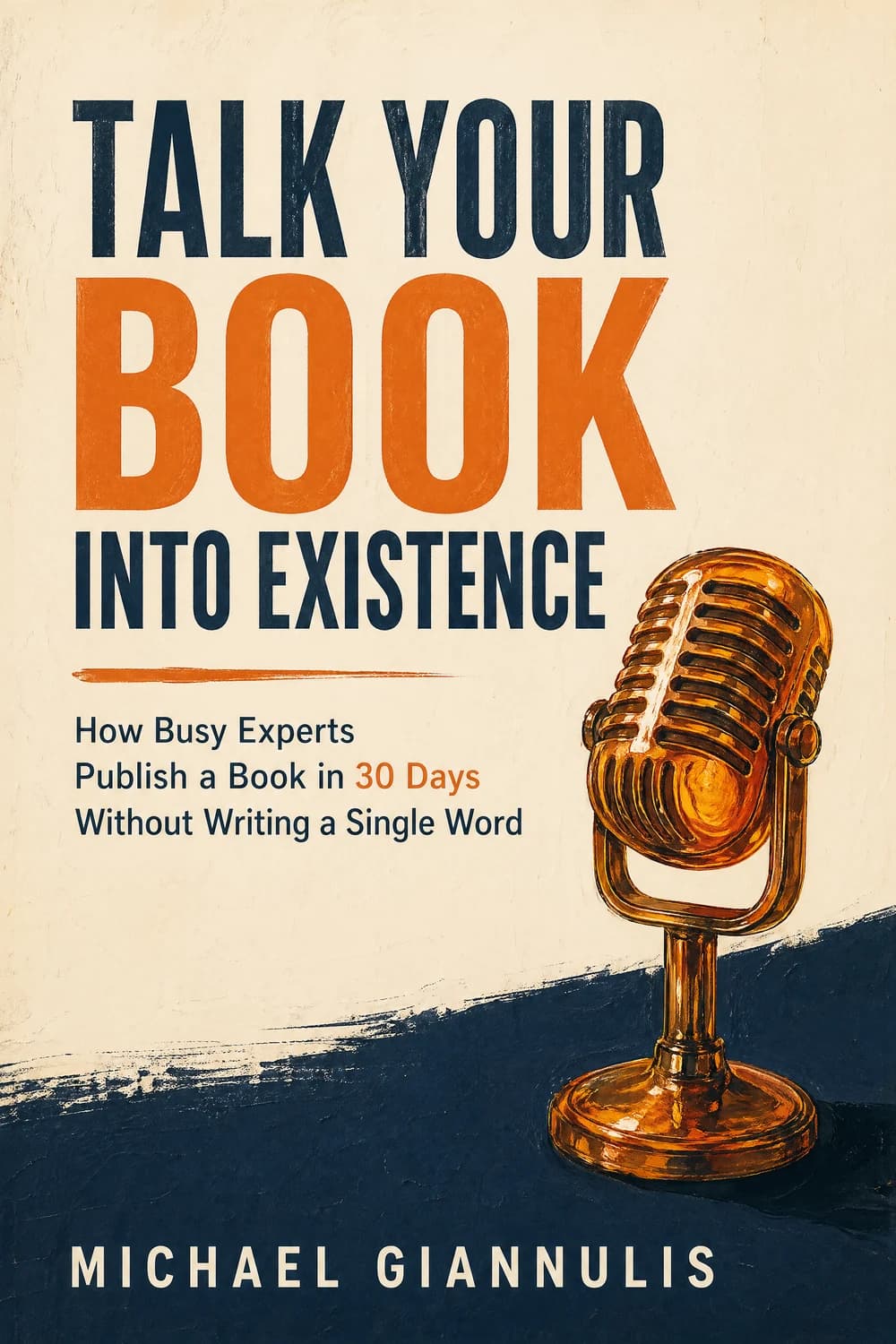
Your book isn’t a product. It’s a credentialing device.
Most business books sell fewer than 250 copies, less than half the attendance of a single industry conference, and still rewrite the author’s career. That only sounds impossible until you understand what the book is actually for.
For a service professional, a book is not a royalties machine. It is a trust shortcut. A prospect sees it on Amazon, scans the cover, glances at the table of contents, and within 90 seconds files you under category instead of vendor. They may never read a page. The existence of the book did the work.
Picture two financial planners at the same conference. Same 20 years, same expertise, same results. One published eight months ago. She is on the panel, fielding podcast invites, with a line at her table. The other, who actually knows the topic better, is handing cards to the same five people as last year. The difference is not knowledge. It is authority.
“Expertise is what you know. Authority is what other people know about you.”
The math of the unwritten book
The most expensive cost in a service business is invisible, because you never see the money you didn’t earn.
Conservative opportunity cost of waiting five years to publish
How long a prospect takes to validate your authority from a book
Time the traditional writing path demands: about 12.5 work weeks
Time the dictation method asks of you instead
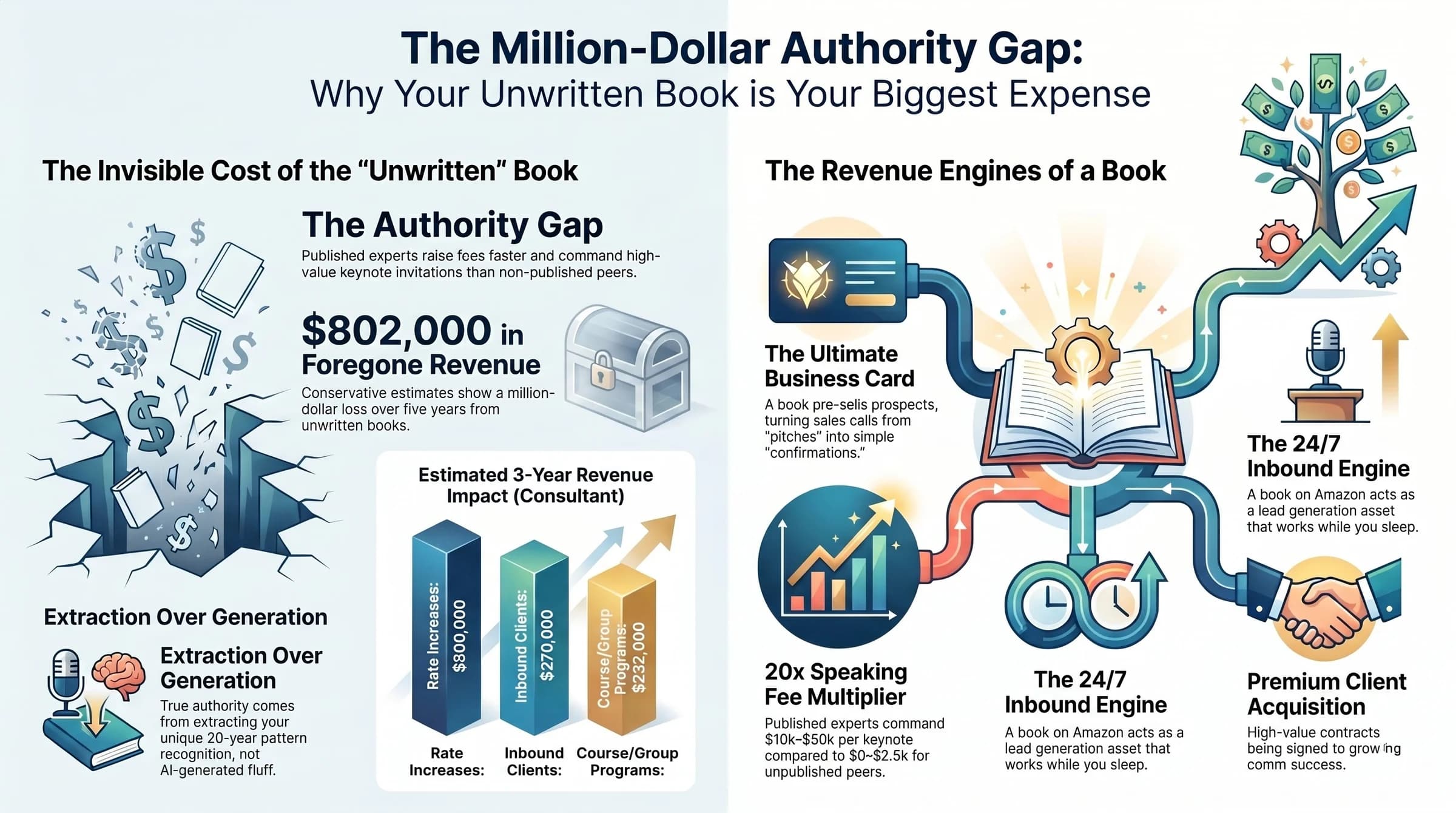
The $922K breaks down across foregone rate increases, keynote fees, inbound clients, and a course built on the book’s framework, for a single consultant, over a few short years.
Where the million dollars goes
The invisible cost on the left. The five revenue engines a published book switches on, on the right.
The whole idea, in one sitting
A guided walkthrough of the authority gap, the five-year math, and the five revenue mechanisms, before you ever open the book.
Five ways a book grows the business
You do not need all five. Pick the two that fit your model before you write a word, then build the entire book around those jobs.
The Ultimate Business Card
Handing a prospect your book pre-sells them before you say a word. The sales call stops being a pitch and becomes a confirmation. Published experts report 20–40% higher close rates.
The Speaking Circuit Ticket
Organizers use a book to vet who belongs on stage. Unpublished experts speak for free; authors command $10,000–$50,000 per keynote. You stop asking permission to speak.
The Fee Multiplier
A book repositions you out of the price-shopping comparison set into a category of one. The ceiling on your old fees becomes your new floor. Most authors raise rates 25–50% within 18 months.
The 24/7 Inbound Engine
Amazon is the world’s third-largest search engine. Your book sits there day and night with no ad spend and no retainer, delivering leads who arrive already sold on your way of thinking.
The IP Foundation
Your chapters become the curriculum for courses, group programs, and licensing, plus two years of newsletter and social content you can extract instead of invent.
Pick your two. Build the book around them.
High-ticket consultant? Business Card + Fee Multiplier. Coach building a platform? Speaking + IP Foundation.
The shift that changes everything: extraction, not generation
The same AI can do two opposite jobs. One produces soulless, un-copyrightable filler. The other captures the real you. Knowing the difference is the whole game.
You give the AI a two-sentence prompt; it remixes the internet. The thoughts, structure, and prose belong to the machine, which means they belong to no one. It’s a Wikipedia article in a hardcover jacket, and it can’t be copyrighted.
You do the talking: your stories, frameworks, contrarian opinions, 20 years of pattern recognition. The AI listens, organizes, and shapes your spoken words into prose. The intellectual substance is 100% human, so the work stands on solid copyright footing, the same precedent as a ghostwriter.
The analogy that makes it click: generation asks the AI to invent a house. Extraction hands it your blueprint, your lumber, and your fixtures and asks it to swing the hammer. You still own the house. Read the full copyright analysis of AI-assisted books.
Voice matters more than content
The raw information in almost any business book is free on Google in 30 seconds. What readers actually buy is your perspective: the rough edges, the bias, the way you see the data. The book breaks voice into six measurable parts it calls your Voice DNA.
Sentence Architecture
Short punchy jabs or long, building paragraphs: your natural rhythm and start-words.
Vocabulary Fingerprint
The words you reach for. “Bulletproof,” never “robust.”
Rhetorical Patterns
How you persuade: story first, stat first, or your signature analogies.
Transition Habits
The connective tissue. “Here’s the thing…” Never “furthermore.”
Emotional Register
What lights you up, what bores you, what you’ll share and won’t.
Signature Phrases
The catchphrases your clients could quote back to you.
The Shortcut Test
Read three pages of any draft out loud. Then read three of your everyday work emails out loud. If they sound like two different people wrote them, the book is dead on arrival. An alarming majority of traditionally published business books fail this test. They sound like “author voice,” not the actual person.
Give the book a spine before you write a word
Structure paralysis is what kills most books: 20 years of knowledge, no idea what goes first, a graveyard of “outline-draft-4” docs. The fix is to answer seven questions first. They turn a blank page into a blueprint.
And the one that stops everyone (“I don’t have a signature system”) is answered with a kitchen. Millions have the same ingredients. Only your grandmother makes the sauce her way. Her sequence, her ratios, her feel. That’s your system. You don’t invent the tomato.
- 1
Personal Path
The origin story that earns the reader’s trust.
- 2
Foundational Frustration
The accepted industry wisdom you know is wrong.
- 3
Transformation Target
The measurable change the reader walks away with.
- 4
Signature System
Your proprietary sequence: your grandmother’s recipe.
- 5
Precise Prospect
Exactly who the book is written for.
- 6
Competitive Contrast
How your book differs from the three beside it on the shelf.
- 7
Author’s Ambition
The business job the book is hired to do.
Your failure to publish is structural, not a lack of willpower
Every traditional path was built for professional writers, not for busy experts. Here’s why each one breaks down.
| Path | Typical Cost | Timeline | Core Failure |
|---|---|---|---|
| Write It Yourself~500 hours · 6–18 months | ~500 hours | 6–18 months | The time and skill gap: experts speak, they don’t write prose. |
| Hire a Ghostwriter$30k–$80k · 6–18 months | $30k–$80k | 6–18 months | Voice mismatch: the writer’s voice replaces yours. |
| Prompt-Based AI$0–$500 · 1–2 weeks | $0–$500 | 1–2 weeks | No copyright, no voice. Generic, Wikipedia-style filler. |
| Hybrid Coach + AI$5k–$15k · 8–16 weeks | $5k–$15k | 8–16 weeks | Accountability bolted onto a broken generation engine. |
“There was no keyboard. I talked about my life the way I would talk about it at the dinner table.”
Prefer to listen? Here’s the full episode.
A 70-minute conversational deep dive through every idea in the book: the authority gap, the four failed paths, Voice DNA, the seven pillars, the three-layer interview system, and the 90-day post-launch plan. Great for a commute or a walk.
Resources & companion materials
Everything from the talk, in one place: share with a colleague or revisit later.
Get the full book
Kindle, paperback, and Audible. Pick the format that fits how you learn.
We built the system the book describes.
Dictate is the extraction method, productized. You talk; our AI conducts the structured interviews, captures your Voice DNA, and writes every chapter in the way you actually speak. You review in Google Docs and leave comments. We handle the rest, all the way to a published, copyright-protected book on Amazon.
No keyboard. No 500 hours. Roughly 10–12 hours of conversation about a subject you already know cold. If that sounds like the right way to finally get your book done, the lightest first step is a conversation.
Find a time that works
A relaxed, no-pressure call to talk through your book idea and which two revenue mechanisms fit your business. Bring questions.
Frequently asked questions about writing an authority book
The questions experts ask before they decide to finally write the book.
Why should a consultant or expert write a book?
For a service professional, a book is a credentialing device: a 90-second trust shortcut that repositions you from vendor to category authority. It pre-sells prospects before sales calls, opens paid speaking, justifies higher fees, and generates inbound leads on Amazon around the clock. Most business books sell modestly yet still transform the author’s career because their value is positioning, not royalties.
How long does it take to write a business book?
The traditional path takes roughly 500 hours of writing, outlining, and editing: about 12.5 full work weeks spread over 6 to 18 months. By talking your book into existence through structured interviews instead of typing, the author’s time investment drops to roughly 10 to 20 hours of recorded conversation over four to six weeks.
Can you copyright a book written with AI?
It depends on how the AI is used. Content generated from a short prompt lacks sufficient human authorship and generally cannot be copyrighted. But when AI is used to extract and organize your own spoken ideas, stories, and frameworks, the human contribution is substantial and dominant, legally comparable to a traditional ghostwriting relationship, where the expert is recognized as the author.
What is the difference between AI generation and AI extraction?
Generation asks the AI to invent content from its training data, producing generic, un-copyrightable prose. Extraction starts with you: you provide the stories, frameworks, and opinions through recorded interviews, and the AI organizes and shapes your words into your own voice. Generation invents a house; extraction hands the AI your blueprint and materials and asks it to swing the hammer. You still own the house.
How do you make an AI-written book actually sound like you?
By capturing your Voice DNA: six measurable components covering sentence architecture, vocabulary fingerprint, rhetorical patterns, transition habits, emotional register, and signature phrases. The test is simple. Read three pages of the draft and three of your everyday emails out loud. If they sound like two different people, the voice wasn’t captured.
Want the productized version of this method? See how Dictate works or explore it for consultants, coaches, and financial advisors.
Your expertise is already there.
It is waiting to become compounding authority. Close the blank document. Step away from the keyboard. Talk your book into existence, and claim the position that should already be yours.
Available on Kindle, paperback, and Audible