How to Write an Authority Book (Without Typing It)
Michael Giannulis··8 min read
Two experts stand at the same conference. Same twenty years of experience, same results, same depth of knowledge. One published a book eight months ago; the other didn't. The published expert is on the panel, fielding podcast invitations, with a line of prospects at her table. The other — who may actually know the topic better — is handing out cards to the same five people as last year.
The difference isn't expertise. It's authority. As the saying goes: expertise is what you know; authority is what other people know about you. An authority book closes that gap. This guide explains what an authority book actually does for your business, why traditional writing paths fail busy professionals, and how to write one by talking instead of typing.
What an Authority Book Really Is
Most business books sell fewer than 250 copies — less than half the attendance of a single industry conference — and still transform the author's career. That only makes sense once you understand what the book is for. For a service professional, a book isn't a moneymaker through sales. It's a credentialing device.
A prospect sees your book on Amazon, scans the cover, glances at the table of contents, and within 90 seconds files you under "category authority" instead of "vendor." They may never read a page. The mere existence of the book does the work — the same way a medical license or a CFA designation signals competence without anyone reading the underlying coursework.
The Five Revenue Mechanisms of a Published Book
Once that trust signal is in place, a book activates five distinct mechanisms that run in the background of your business:
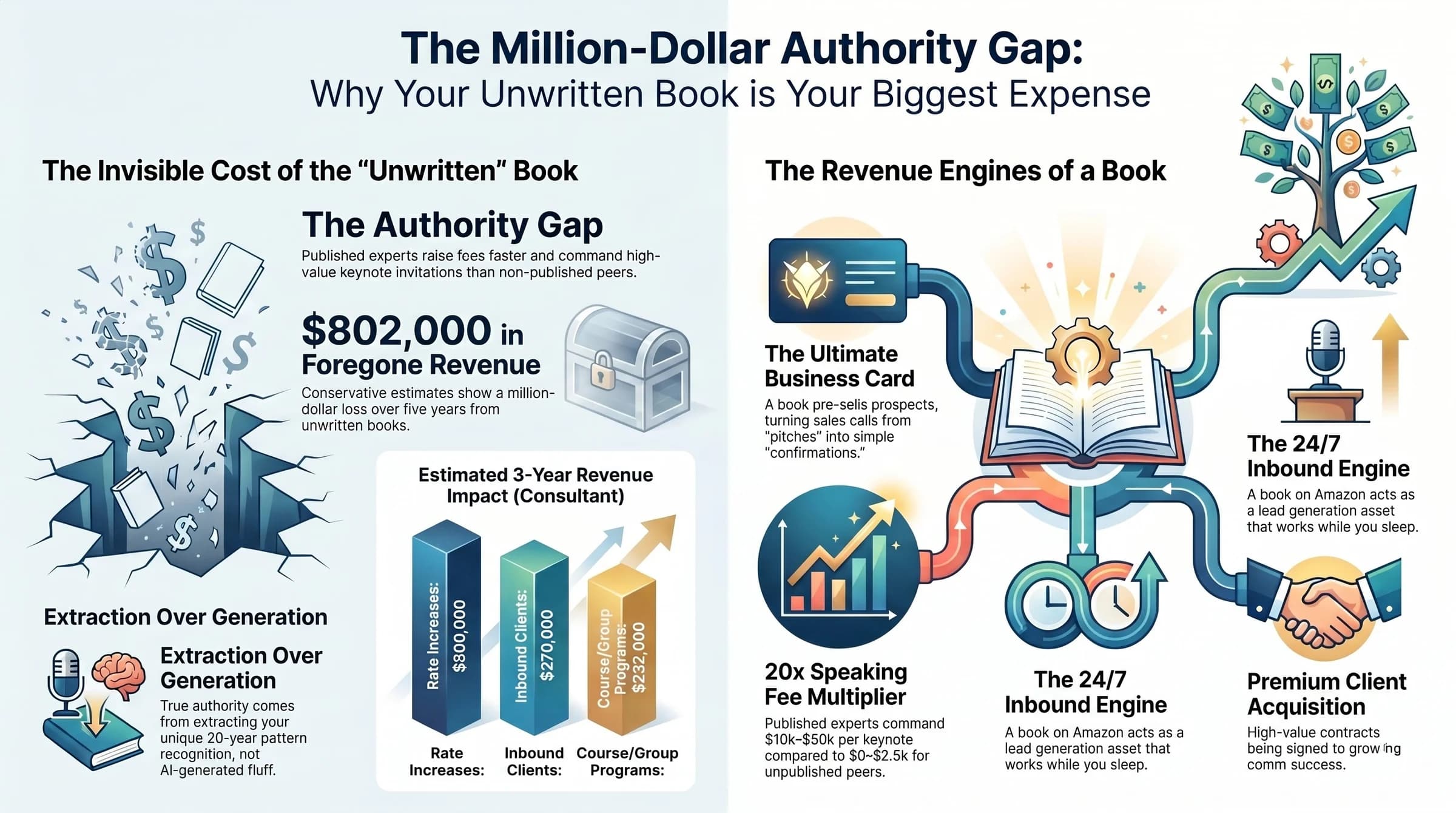
The ultimate business card. Handing a prospect your book pre-sells them before you speak. Sales calls become confirmations instead of pitches — published experts report 20–40% higher close rates.
The speaking circuit ticket. Organizers use a book to vet speakers. Unpublished experts speak for free; authors command $10,000–$50,000 per keynote.
The fee multiplier. A book repositions you out of price-shopping comparison sets. Many authors raise rates 25–50% within 18 months. Your old ceiling becomes your new floor.
The 24/7 inbound engine. Amazon is one of the world's largest search engines. Your book generates warm leads with no ad spend, delivering prospects already sold on your thinking.
The IP foundation. Your chapters become the curriculum for courses and group programs — plus years of newsletter and social content you can extract instead of invent.
You don't need all five. Pick the two that fit your model — a high-ticket consultant might choose the business card and the fee multiplier — and calibrate the entire book around them.
Why Traditional Paths Fail Busy Experts
If you've tried and stalled, the problem is structural, not a lack of willpower. Every traditional path was built for professional writers, not for experts who run businesses:
1. Write it yourself
A serious nonfiction book takes roughly 500 hours — about 12.5 full work weeks. For an expert billing $400–$1,500 an hour, that's $200,000 to $750,000 in opportunity cost spent staring at a blinking cursor. The free quarter never appears, so the book never ships.
2. Hire a ghostwriter
A competent business-book ghostwriter runs $30,000–$80,000 and 6–18 months. The deeper problem is voice mismatch: because the ghostwriter is physically choosing every word, their voice subconsciously overwrites yours, and the book ends up sounding like a polished stranger impersonating you.
3. Prompt-based AI
Typing "write a book about leadership" into a chatbot produces structurally plausible but generic, soulless prose — a statistical remix of the internet. It also can't be reliably copyrighted, because content generated from a thin prompt lacks sufficient human authorship.
4. Hybrid coach + AI
Bolting a $5,000–$15,000 human accountability coach onto the same broken prompt-based generation engine just guarantees the completion of a generic, uncopyrightable asset.
The Better Way: Extraction, Not Generation
The breakthrough is a shift in how AI is used. Generation asks the AI to invent content from its training data. Extraction starts entirely with you: you provide the stories, frameworks, contrarian opinions, and hard-won pattern recognition through recorded interviews, and the AI organizes and shapes your spoken words into prose in your own voice.
The analogy that makes it click: generation asks the AI to invent a house. Extraction hands the AI your blueprint, your lumber, and your fixtures and asks it to swing the hammer. You still own the house. Because the intellectual substance originates with you, extraction stands on solid copyright footing — legally comparable to a traditional ghostwriting relationship. (We cover the full legal picture in our analysis of copyright for AI-assisted books.)
Capturing your Voice DNA
Voice matters more than content, because the raw information in most business books is free on Google in 30 seconds — what readers buy is your perspective. Voice can be broken into six measurable components: sentence architecture, vocabulary fingerprint, rhetorical patterns, transition habits, emotional register, and signature phrases. The test is simple: read three pages of your draft and three of your everyday emails out loud. If they sound like two different people, the voice wasn't captured.
The Math: 20 Hours Instead of 500
When you talk your book into existence through a structured, three-layer interview process, the author's time investment drops to roughly 10–20 hours of recorded conversation, spread over four to six weeks — about a subject you already know cold. You're trading 500 hours of isolated typing for a couple dozen hours of engaging conversation. That's the entire point: you don't have to become a writer to share the expertise you already have.
This is exactly the method we built Dictate around. If you'd rather see the productized version, here's how the Dictate process works — from discovery call to a published, copyright-protected book.
Read the Book
The full case — the authority gap, the five-year math, the four failed paths, Voice DNA, the seven pillars, and the 90-day post-launch plan — is laid out in Talk Your Book Into Existence by Michael Giannulis. The companion page includes a free writeup, an 8-minute explainer video, and a 70-minute audio deep dive, and the book is available on Amazon in paperback and Kindle.
Your expertise is already there. It's just waiting to be converted into compounding authority. Close the blank document, step away from the keyboard, and talk your book into existence.
Compliance work is commoditizing fast, and CPA firms that rely on tax prep alone are watching margins shrink. A strategically written book is one of the most effective tools for repositioning your firm as a trusted advisory partner—here's the research-backed case for why, and how successful CPA authors have done it.
Compliance revenue is commoditizing fast, and CPA firms that rely on it are losing ground to software and offshore providers. Research shows that the firms making the leap to advisory do three things simultaneously: free up capacity, package expertise, and publish thought leadership that earns trust before asking for a sale. A book is one of the highest-leverage tools in that third step.
Self-published authors saw median income rise 53% year over year to $12,749, according to an ALLi survey—a striking contrast to the $2,000 median reported by traditionally published authors. For freelance creatives, the data reveals something even more interesting: a book isn't just a revenue source, it's a business transformation tool that unlocks speaking gigs, courses, consulting retainers, and a personal brand that outlasts any single client relationship.
Mike Giannulis··8 min read
Ready to Turn Your Expertise Into a Book?
Start with a free discovery call. No commitment, no pressure — just a conversation about your book.