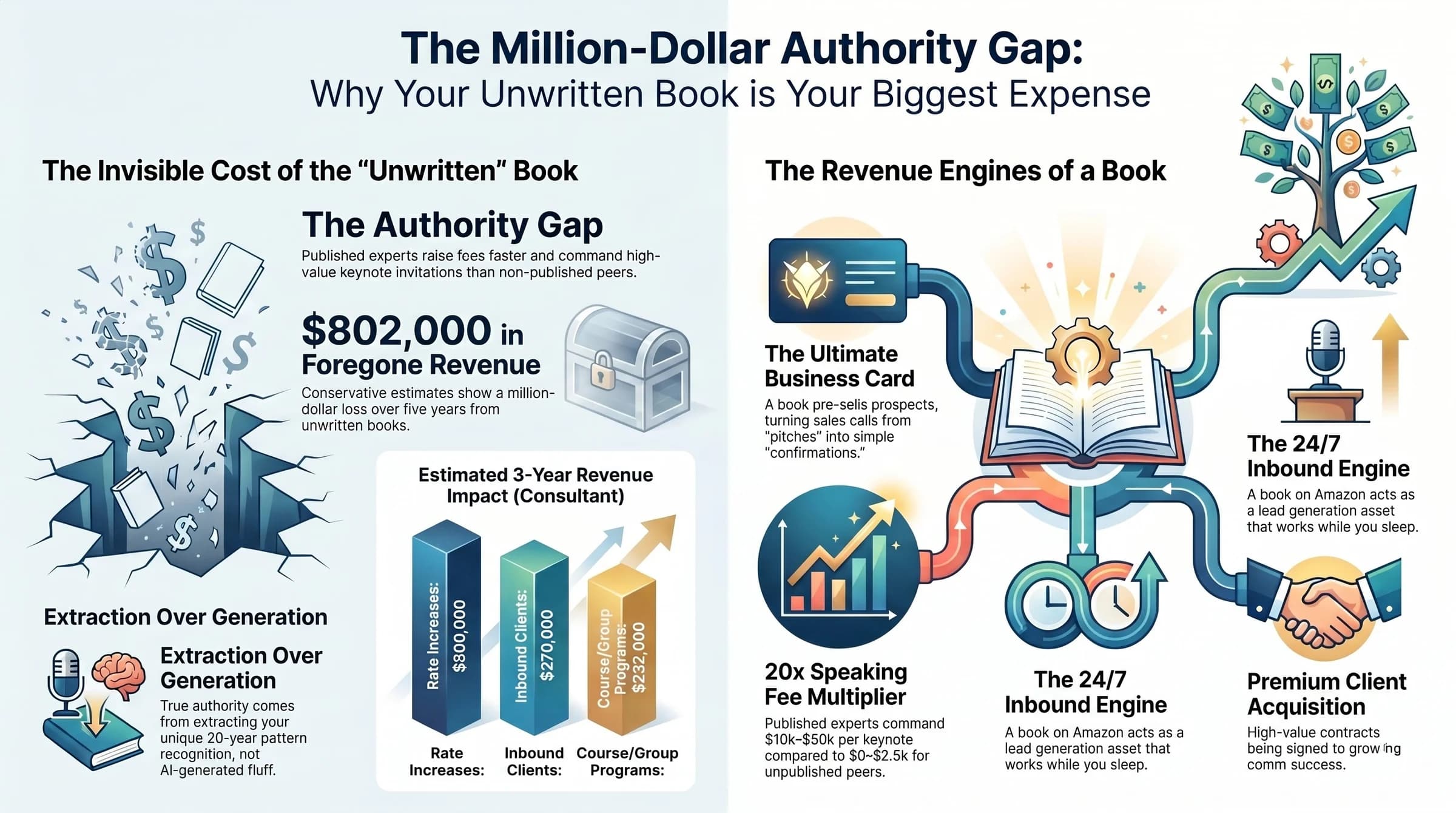
Yes — coaches building group programs around a single published book report cohort revenues of $30,000–$35,964 per cohort, with annualized figures reaching $71,928 to $288,000 depending on pricing and cadence. The book functions as a shared curriculum that removes the need to build content from scratch while giving each cohort a structured, repeatable framework.
Here is the number that should reframe how you think about your next twelve months: $288,000 in annual coaching revenue — from the same delivery hours you are already spending on one-to-one clients. That figure comes from a monthly cohort model documented in coaching industry case studies, where the only structural change from a standard 1:1 practice was shifting delivery to groups. The catalyst that makes the model credible enough to fill those cohorts? A published book.
This is not a theory. Coaches across the executive, life, and team coaching verticals are doing this right now — turning chapters into session themes, exercises into homework, and frameworks into the shared language that holds a cohort together. If your income is currently capped by the number of hours in your calendar, this article is the clearest map available to break that ceiling.
Why the Income Ceiling Exists — and What Actually Breaks It
The one-on-one coaching ceiling is structural, not motivational. Trading time for money means your revenue is hard-capped by your available hours, your per-session rate, and your personal bandwidth. The only escape routes are raising rates (limited by market tolerance) or adding clients (limited by hours). The group model is the third option that most coaches underestimate.
Group coaching consistently produces 2x to 5x more revenue per hour than 1:1 work, with some analyses showing a 4x hourly yield or even a 7.2x higher effective hourly leverage versus individual coaching engagements. Coach Foundation's group coaching research and Keedia's revenue model analysis both document this leverage gap.
The barrier to group coaching isn't the business model — it's the credibility and structure problem. Group programs need a reason for strangers to trust a shared container. They need a framework that keeps ten or twelve people aligned. They need a curriculum that does not require you to rebuild content from scratch for every cohort. A published book solves all three at once. Learn more about how coaches are using ghostwriting to build that credibility faster.
The Credibility Gap Group Programs Face
According to community insights from coaching forums and practitioner communities, group coaching typically requires a stronger front-end funnel and more demonstrated trust than 1:1 services. Prospective participants are not just buying your time — they are buying into a structured experience with strangers. A book functions as a pre-trust mechanism: it demonstrates your methodology before anyone writes a check, reduces perceived risk, and makes the offer feel like an established program rather than a speculative experiment.
This is why the book's revenue effect is described in the research as "indirect but meaningful" — it improves conversion into paid cohorts, supports higher pricing, and creates a repeatable launch engine for future cohorts rather than directly generating revenue on its own.
The 6 Book-Based Business Models Coaches Are Using Right Now
Community research from coaching forums and practitioner networks identifies six distinct models for building group programs around a published book. Each has a different revenue profile, delivery format, and audience fit.
1. Book-Based Group Coaching Program
The most common model: a coach builds a multi-session group program around one book, using its chapters to structure each meeting. Jennifer Britton's Effective Group Coaching is explicitly described as a roadmap for coaches to "create, implement, and promote" their own group coaching program. From One to Many is similarly noted as offering practical tools and resources for group and team coaching engagements — and has been selected as a resource text by multiple coach training schools. From One to Many's resource library documents this application directly.
2. Book-as-Facilitator Guide
Here the book is used internally — as a playbook the coach references to design group dynamics, exercises, and session flow. Participants may not read the book themselves; instead, the coach translates its structure into facilitated experiences. Washington Coaching Group describes anchoring its consulting work in a specific book's strengths-based framework, using its concepts to "drive the structuring of critical conversations."
3. Book Study / Conversation Group
Participants receive the book (or a shared copy) and the coach facilitates discussion rather than lecturing. Positive Coaching Alliance's Jim Thompson describes the goal as encouraging "conversations rather than meetings" — a distinction that creates psychological safety and deeper engagement. Coach Kate Leavell's model, documented in Books Make a Difference, uses a book to create poster-making and team discussion activities that reinforce concepts between sessions.
4. Team Culture Intervention
Coaches use a book to establish common language and reinforce behavioral norms across a team. The book becomes a shared reference point — displayed as posters, referenced in stand-ups, cited in retrospectives. The Five Dysfunctions of a Team is frequently cited as a discussion framework in team coaching engagements of this type, giving the coach a pre-built diagnostic model that teams immediately recognize.
5. Curriculum for Workshops, Trainings, and Webinars
Books are repurposed into workshop curricula for HR audiences, leadership development programs, and coach training schools. From One to Many is specifically noted as relevant for "facilitators, HR professionals, and trainers" — indicating a B2B consulting revenue stream that extends well beyond individual coaching clients.
6. Expert-Led Consulting with a Published Framework
The highest-leverage model: a coach anchors all services — speaking, consulting, group programs, and 1:1 work — in a specific book's intellectual framework. The book becomes the brand. Every engagement references it. Pricing becomes easier to defend because the framework is published, documented, and citable. This is exactly the approach outlined in turning your coaching methodology into a book without losing your voice.
What the Revenue Actually Looks Like: Real Cohort Numbers
Group coaching cohort revenue ranges from $15,000 to $35,964 per cohort at per-seat pricing of $1,000–$3,000, with annualized revenue reaching $71,928 to $288,000 depending on cadence and model design. These figures come from documented coaching business case studies, not projections.
Here is what the data shows across multiple sources:
Model
Participants
Price Per Seat
Cohort Revenue
Annual (2 cohorts)
Standard cohort
10
$3,000
$30,000
$60,000
Mid-tier cohort
12
$2,997
$35,964
$71,928
Monthly cohort model
Variable
Variable
Variable
Up to $288,000
Entry-level cohort
10–15
$1,000–$2,500
$15,000–$35,000+
$30,000–$70,000
Group coaching is typically priced at 30%–50% of a private 1:1 package — keeping it accessible to participants who cannot afford your top-tier rate while producing strong per-seat revenue when multiplied across a cohort. This pricing architecture also creates a natural upgrade path: participants who want more individualized attention after the group program become 1:1 clients at your full rate.
"If your book helps you fill even one extra cohort, the incremental revenue can be substantial because the model is already highly leveraged."
— Coaching business model analysis, multiple industry sources [2][3][9]
The Step-by-Step Framework: Book to Group Program
The pattern that emerges most consistently across coaching communities follows a five-stage sequence that converts a book into a functioning group program curriculum. This is not theory — it is the operational model coaches are describing in forums, practitioner networks, and published coaching resources.
Stage 1: Read the Book as a Curriculum Designer, Not a Reader
The first pass through your manuscript — or through a book you are building your program around — should map chapters to session themes. Ask: What is the transformation arc? Where are the natural inflection points? Which concepts require practice before the next concept lands? A six- to twelve-chapter book typically maps to a six- to twelve-week program, with one chapter per session serving as the anchor.
Stage 2: Translate Chapters into Session Themes
Each chapter becomes a session objective. The concept becomes the teaching moment. The exercises become the in-session activity. The reflection questions become the discussion prompts. Jennifer Britton's Effective Group Coaching model, as documented in coaching community resources, treats each book section as a "readmap" for what a functioning group needs at that stage of development.
Stage 3: Use Exercises and Reflection Questions in Live Sessions
The most effective group sessions are not lectures — they are facilitated experiences. The book's exercises do the content heavy lifting; your role is to hold the space, deepen the reflection, and connect individual insights to the group's shared framework. This is the moment where your facilitation skill becomes the differentiator — not the content itself.
Stage 4: Assign Implementation Between Sessions
Between sessions, participants apply the concept to their real context. This is where transformation actually happens — and it is also where a published book creates an advantage. Participants can reference the relevant chapter independently, revisit the exercise, and arrive at the next session with actual implementation experience rather than just intellectual familiarity.
Stage 5: Reinforce with Shared Language, Artifacts, and Action Plans
The book creates a shared vocabulary that persists beyond the program. Teams that complete a book-based coaching engagement often display key concepts visually — posters, scorecards, behavioral agreements — as a form of ongoing accountability. This reinforcement loop is documented in the sports coaching context via Books Make a Difference, where coaches use book-derived team norms as visible culture artifacts.
Why Your Competing Coaches Are Losing — and How a Book Changes That
Most coaches building group programs create courses: slide decks, recorded modules, Notion wikis. These have the same liability — they are content, not frameworks. Participants complete the modules and forget them. There is no shared artifact, no common language, no published methodology that persists after the program ends.
A book is different. It is a physical or digital object that participants keep. It is citable. It is giftable. It sits on a shelf and signals your methodology to every person who visits your client's office. It creates a category of one — coaches who have a book are, in the perception of most buyers, operating at a different level than coaches who have a course.
This is why the research consistently frames the book's impact as improving conversion into paid cohorts and supporting higher pricing. The book does not just market your program — it justifies the premium.
The Lead Magnet That Converts to High-Ticket
A book functions as the highest-quality lead magnet in the coaching market because it delivers genuine value before any sale is made. Unlike a PDF checklist or a free webinar, a book demonstrates your full methodology — which means prospects arrive at a sales conversation already sold on your framework. The conversion question shifts from "does this coach know what they are talking about?" to "do I want this coach to facilitate this for my team?"
For coaches building toward high-ticket group offers, this pre-trust mechanism is the difference between a full cohort and a half-empty one.
How to Price Your Book-Based Group Program
Book-based group coaching programs are typically priced at 30%–60% below equivalent 1:1 coaching packages, with per-seat pricing ranging from $1,000 to $3,000 for a standard 6–12 week cohort. This range reflects both market norms and the leverage economics of group delivery.
A practical pricing architecture for a first cohort:
Founding member rate: $1,500–$2,000 per seat (8–10 participants = $12,000–$20,000 cohort)
Standard rate after first cohort: $2,500–$3,000 per seat (10–12 participants = $25,000–$36,000 cohort)
VIP upgrade: Add 1:1 session(s) for $500–$1,500 premium per participant
Institutional / corporate rate: $5,000–$15,000 flat fee for team cohorts of 6–12
Running two cohorts per year at the standard rate produces $50,000–$72,000 annually from a single program — before any 1:1 work, speaking, or book sales. A monthly cohort model with consistent enrollment can reach the $288,000 figure documented in industry case studies.
For coaches considering whether to hire support for the book itself, it is worth noting that professional book writing services exist across a wide range of investment levels. Reedsy ghostwriter costs, for instance, typically range from $30,000 to $100,000+ for full-length nonfiction — a meaningful investment that a single strong cohort can recover. You can get a detailed breakdown of what to expect in our 2026 ghostwriter cost guide. AI-assisted approaches now offer a different path, with faster timelines and lower upfront cost, making the economics more accessible for coaches in earlier scaling stages.
The Books That Coaches Are Actually Using as Group Frameworks
The research identifies four books most frequently tied to the book-based group coaching model in practitioner communities:
Effective Group Coaching (Jennifer Britton) — Described as a complete roadmap for coaches to create, implement, and promote group programs. Frequently cited as the definitive operational guide for this model.
From One to Many — Selected as a resource text by coach training schools; explicitly relevant for facilitators, HR professionals, and trainers building group and team engagements.
Group and Team Coaching: The Secret Life of Groups — A framework-focused resource for understanding group dynamics in coaching contexts.
The Five Dysfunctions of a Team — Widely used as a discussion framework for team coaching engagements, particularly in organizational and executive coaching contexts.
The pattern across all four is consistent: coaches use these books not as reading assignments but as structural scaffolding — a pre-built architecture of concepts, exercises, and progression logic that would take months to develop independently.
If you are building your own book with this application in mind, the structural lesson is clear: write it so chapters can stand alone as session themes, include exercises that translate directly to group facilitation, and design reflection questions that generate conversation rather than individual journaling. This is what it means to write a book that scales your coaching practice.
Building Your Own Framework Book: What the Model Requires
If you want your book to function as the curriculum backbone for a group program, it needs to be structured differently from most coaching books on the market. Most coaching books are written to be read linearly. A curriculum book needs to be designed to be experienced sequentially — with each chapter delivering a transformation the reader can act on before moving to the next.
Key structural requirements for a book designed to anchor a group program:
A clear transformation arc: Where does the reader start? Where do they end? What changes between chapter one and the final session?
Chapter-level exercises: Each chapter should include at least one exercise that works in a group setting — not just individual reflection.
Discussion questions: Built in, not added as an afterthought. These become your session facilitation prompts.
A proprietary framework: A named model, matrix, or sequence that becomes the shared language of the cohort. This is what participants remember and reference after the program ends.
Implementation assignments: Between-session application activities that connect the book's concepts to participants' real contexts.
This is where services like Dictate become practically relevant for coaches at the scaling stage. Dictate helps coaches articulate their methodology in a form that scales — from one-on-one to one-to-many — by structuring the book around the same logic a group curriculum requires. Your book becomes the curriculum, and the curriculum becomes the program. The intellectual work you have already done in your coaching practice gets captured, structured, and published in a form that works across cohorts, years, and client types.
Coaches who want to hire a nonfiction ghostwriter or use AI-assisted writing tools to accelerate this process now have more options than ever — and the economics make more sense when the resulting book is mapped directly to a revenue-generating group program rather than sitting as a standalone asset.
Frequently Asked Questions
How much can a book-based group coaching program generate annually?
Based on documented coaching business models, two cohorts per year at $2,997–$3,000 per seat with 10–12 participants generates $60,000–$71,928 annually. A monthly cohort model using the same delivery structure can reach $288,000 annually — from the same hours previously spent on one-to-one clients.
What is the typical price per seat for a group coaching program?
Group coaching is typically priced at 30%–50% of an equivalent 1:1 package, with per-seat pricing ranging from $1,000 to $3,000 for a standard 6–12 week cohort. Corporate or team cohorts are often priced as flat-fee engagements ranging from $5,000 to $15,000.
How do coaches structure sessions around a book?
The most common pattern is: read the book → translate chapters into session themes → use exercises in live group sessions → assign implementation between sessions → reinforce with shared language and action plans. Each chapter typically anchors one session, with the book's exercises and reflection questions serving as the facilitation curriculum.
What books do coaches use to build group programs?
The most frequently cited books in coaching practitioner communities include Effective Group Coaching by Jennifer Britton, From One to Many, Group and Team Coaching: The Secret Life of Groups, and The Five Dysfunctions of a Team. Coaches either build programs around these existing frameworks or author their own proprietary methodology book to use as curriculum.
How much does it cost to hire a ghostwriter for a coaching book?
Reedsy ghostwriter costs for full-length nonfiction typically range from $30,000 to $100,000+, depending on scope and the writer's experience level. AI-assisted book writing services offer faster timelines and significantly lower investment — making the economics more accessible for coaches whose book is mapped directly to a group program revenue model.
Can I use management consulting books as the basis for a group program?
Yes — books for management consulting and leadership development are frequently used as group program curricula in executive coaching contexts. The key is selecting a book with a clear framework, actionable exercises, and a transformation arc that maps to your clients' specific development goals. Many executive coaches also author their own framework books to establish proprietary methodology.
Why does a book help fill group coaching cohorts more effectively than a course?
A book functions as a pre-trust mechanism that demonstrates your full methodology before any sale is made. Unlike a course, it is a published, citable artifact that persists in the participant's environment after the program ends — creating ongoing credibility and referral potential. Research consistently shows that the book's impact on group program revenue is indirect but significant, improving conversion rates and supporting higher per-seat pricing.
What is the revenue leverage of group coaching versus 1:1 sessions?
Group coaching consistently produces 2x to 5x more revenue per hour than one-to-one coaching, with some documented models showing 4x hourly yield or a 7.2x higher effective hourly leverage. This leverage differential is what makes the group model structurally superior for coaches whose income is currently capped by available hours.
For consultants, coaches, and advisors, an authority book is a credentialing device — not a product. Here’s what it does for your business, why the traditional paths fail, and how to write one by talking instead of typing.
Discover how to create compelling authority book outlines that position you as a thought leader in your industry. Learn proven frameworks and avoid common mistakes.
Publishing a book transforms professionals into industry authorities, generating measurable business growth through enhanced credibility, new revenue streams, and expanded market reach.
Dictate Team··6 min read
Ready to Turn Your Expertise Into a Book?
Start with a free discovery call. No commitment, no pressure — just a conversation about your book.