Here's a startling reality: 73% of decision-makers trust thought leadership content, but only 15% of it is rated as excellent. For executive coaches with proprietary methodologies, this presents both a massive opportunity and a daunting challenge. Your unique framework could be the differentiator that cuts through the noise—if you can translate it authentically into book form.
The coaching industry is flooded with generic leadership books written by ghostwriters who've never sat across from a burned-out CEO or guided a team through transformation. Meanwhile, coaches with proven methodologies remain trapped in the one-on-one revenue ceiling, watching competitors with published books attract group programs and speaking opportunities.
The Hidden Cost of Keeping Your Methodology to Yourself
Every day you delay publishing your coaching framework, you're leaving money on the table. Published coaches report that books transform their businesses by amplifying authority and creating evergreen assets, with clients noting "full client rosters, media breakthroughs, and scaled income."
Consider this: while your methodology currently lives scattered across session notes and workshop materials, other coaches are systematically converting their frameworks into multiple revenue streams. One speaker discovered that turning book content into a corporate keynote "fully recouped the book's investment," shifting opportunities from low-paying gigs to premium engagements.
Why Most Coaching Books Fail (And Yours Doesn't Have To)
The research reveals that coaches face amplified hurdles when writing about their methodologies compared to general authors. Here are the biggest challenges that trip up even experienced coaches:
1. The Time Trap
"Lack of time and constant distractions" ranks as the top challenge for business leaders writing books. For coaches, this is particularly brutal because running client sessions and workshops leaves zero bandwidth for the deep reflection required to distill years of intellectual property.
The solution isn't finding more time—it's treating writing like a client appointment. Research shows that "consistency trumps sporadic bursts," suggesting coaches should schedule 500-word sessions three times per week rather than waiting for inspiration.
2. The Structure Problem
Coaches often have "brilliant insights swirling," but without proper structure, books become "meandering messes" that cram unrelated techniques, diluting the core methodology. The research emphasizes that "rushing without a clear plan" and "skipping the crucial outline phase" leads to unfocused content.
Successful methodology books follow a proven structure: Chapter 1 addresses the problem, Chapters 2-5 detail the framework steps, and Chapter 6 provides case studies. The key is limiting yourself to one framework per book.
Here is what that looks like for a leadership coach whose method has four stages:
Chapter 1, the problem: why capable managers stall when they step into senior roles.
Chapter 2, the framework at a glance: the four stages, with a self-assessment readers can score before going further.
Chapters 3 to 6, one stage each: the principle, an anonymized client story, and an exercise to apply it this week.
Chapter 7, putting it to work: case studies of leaders who used the full framework, plus an implementation guide for their teams.
Insider terms like "somatic resonance" or "paradigm integration" create distance from readers seeking practical transformation. The research shows that "using overly complex industry jargon" and "misunderstanding your target audience" contribute to the flood of low-quality thought leadership.
"Write for your ideal client, not your peers. If your typical client is a busy executive, explain concepts simply: 'Somatic resonance = tuning into body signals for breakthroughs.'"
The Authority Advantage: What Publishing Really Does for Coaches
While direct industry-wide data is limited, consistent patterns emerge from real-world examples of coaches who've published their methodologies:
Revenue Diversification
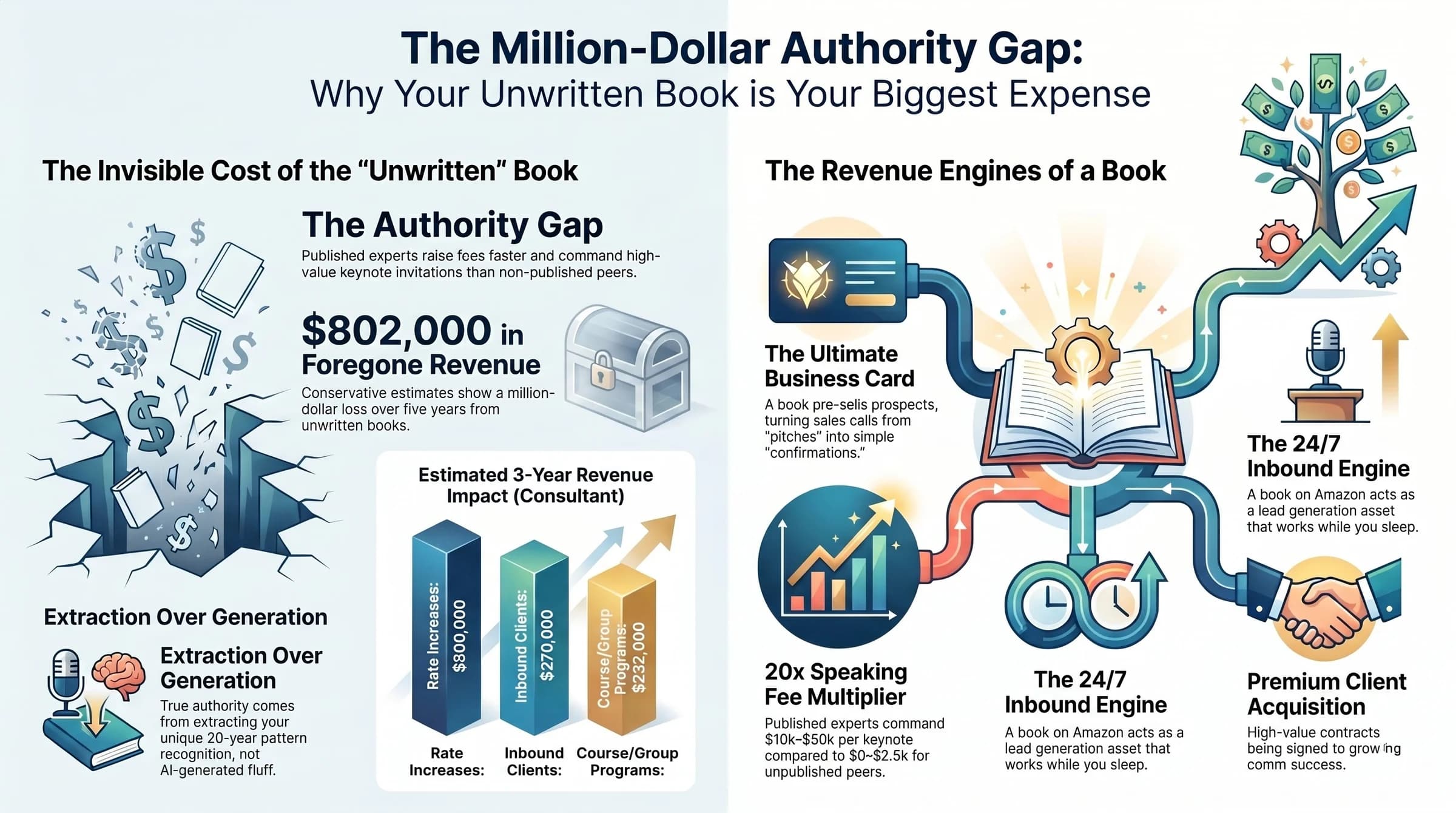
Books unlock multiple income streams beyond one-on-one coaching. Jasmine Wac, who helps coaches convert books into business assets, reports her clients have generated "over $2 million in business revenue since 2018" through "programs, courses, and premium-priced coaching communities."
A consultant who developed a new framework during the writing process leveraged it into digital courses and additional revenue streams. The pattern is clear: 64% of business books profit for authors, but speaking, consulting, and workshops generate far more income than book sales or royalties. The business case for publishing a book breaks those numbers down further.
Revenue Stream
Impact
Example
Speaking Engagements
Premium pricing
One keynote fully recouped book investment
Group Programs
Scalable income
Premium coaching communities
Courses
Passive revenue
Digital framework training
Consulting
Higher fees
Enterprise methodology implementation
Client Acquisition
A published methodology positions you as the expert, attracting ideal clients who self-qualify through your content. Post-publication, one consultant saw "clients line up outside her digital door," achieved bestseller status, and gained media opportunities.
The authority boost is tangible. Handing over a "beautifully bound, professionally printed" book demonstrates confidence and expertise, making you the clear choice over non-published coaches.
Pricing Premiums
Published coaches command higher fees due to perceived expertise and credibility. The research confirms that books enable "premium-priced coaching" and that "nothing establishes niche dominance like a book with your name on it."
This authority justifies premium rates because clients see you as an industry leader rather than just another coach.
Breaking Through the Writing Resistance
Many coaches resist writing because they're conversational, not writers. This is actually an advantage—the best coaching books capture the author's authentic voice and approach.
Overcoming Emotional Blocks
"Fear and self-doubt stops you dead," according to writing experts. For coaches, exposing proprietary methodology risks copycats or rejection, triggering imposter syndrome. Add perfectionism—"words don't match your vision"—and many coaches never start.
The solution is writing a "draft zero" with no editing allowed. Focus on capturing your methodology as you'd explain it to a client, then hire professionals for objectivity and polish.
The Authenticity Solution
The key to maintaining your coaching edge in written form is preserving your natural voice. Interview-based writing captures how you actually talk, the same conversational approach you use with clients. Your book sounds like you, not a ghost.
From Framework to Published Authority: Your Action Plan
Based on successful coaches who've published their methodologies, here's your roadmap:
Audit Your Existing Content: Gather session notes, workshop materials, and client case studies that illustrate your framework in action.
Define Your Core Methodology: Identify the 3-5 step process that consistently delivers results for your clients. This becomes your book's backbone.
Choose Your Publishing Path: Research suggests hybrid publishing offers the best balance of professional quality and market control for coaches, yielding "a high-quality asset tailored to your market."
Plan Your Launch Strategy: Use the book as a foundation for speaking opportunities, group programs, and premium coaching offers.
Avoiding Common Pitfalls
The research identifies several mistakes that derail coaching book projects:
Cramming multiple frameworks: Focus on one core methodology per book
Over-researching: Your experience is the primary source—external research should support, not dominate
Editing while writing: This "slows progress" and kills momentum
Isolation: The "steep learning curve" requires professional support for accountability and industry connections
The Compound Effect of Published Authority
Your book isn't just a one-time asset—it's a compound investment that grows in value. As one successful author noted, books "water the roots" of ongoing growth, creating opportunities that wouldn't exist otherwise.
Published coaches report:
Increased confidence leading to bigger risks and revenue decisions
Steady audience growth and media opportunities
Premium positioning that justifies higher fees
Frameworks and language that enhance all business communications
The writing process itself generates immediate business benefits, helping coaches clarify their methodology and improve their client communications.
Your Methodology Deserves a Bigger Stage
Every successful coach has developed proprietary approaches through years of client work and refinement. Your methodology represents genuine intellectual property that could transform other leaders' lives and businesses—but only if you publish it.
The coaching industry needs more excellent thought leadership, not more ghostwritten fluff. Your authentic voice and proven framework could be exactly what decision-makers are seeking in that crucial 15% of excellent content.
The question isn't whether you have something valuable to share—you do. The question is whether you'll let other coaches capture the opportunities that should be yours while your methodology remains hidden in session notes and workshop slides.
Your edge doesn't disappear when you publish—it multiplies. Your authentic voice, combined with your proven framework, becomes the foundation for everything from keynote speeches to premium programs. The coaches winning in today's market aren't just good at what they do; they're published authorities who've made their expertise accessible to the leaders who need it most.
Books become powerful client acquisition tools and transform your coaching practice from a service business into a scalable authority platform that works for you, even when you're not in the room.
Frequently Asked Questions
How long does it take to turn a coaching methodology into a published book?
Most coaches complete their methodology books in 3-6 months with a structured approach, focusing on one core framework rather than trying to include everything they know.
Will publishing my methodology help competitors copy my approach?
Publishing actually protects your intellectual property while establishing you as the original authority. The bigger risk is remaining unknown while competitors publish first.
Can I maintain my conversational coaching style in a written book?
Absolutely. The best coaching books preserve the author's natural voice through interview-based writing and conversational explanations rather than academic jargon.
What's the ROI of publishing a coaching book?
While 64% of business books profit directly, the real ROI comes from speaking opportunities, premium coaching programs, and authority-based pricing that can generate millions in additional revenue.
Should coaches choose traditional, self-publishing, or hybrid publishing?
Research suggests hybrid publishing offers the best balance for coaches, providing professional quality and market control while yielding a high-quality asset tailored to your specific market.
Learn how to transform your expertise into a powerful lead generation engine with book marketing. This comprehensive guide covers strategies, implementation steps, and proven tactics for using books to attract and convert prospects.
A published book is the highest-leverage marketing asset a consultant can own. Learn how to turn your consulting methodology into a book that generates inbound leads and premium positioning.
For consultants, coaches, and advisors, an authority book is a credentialing device — not a product. Here’s what it does for your business, why the traditional paths fail, and how to write one by talking instead of typing.
Mike Giannulis··8 min read
Ready to Turn Your Expertise Into a Book?
Start with a free discovery call. No commitment, no pressure — just a conversation about your book.